Master EUMDR 2017/745 | Clause-by-Clause Breakdown | Your Complete 10-Week Implementation Guide.
Medical Device Insights - Issue #29 March 22, 2026

Hi There, 👋
Exciting news! After completing our ISO 13485 and ISO 14971 series, you asked for more. Today, I’m launching a brand new 10-week series: EU MDR Mastery - Your Complete Guide to Medical Device Regulation Compliance.
If you sell or plan to sell medical devices in Europe, this series is essential.

Why this series?
EU MDR 2017/745 is mandatory for all medical devices sold in Europe. It’s the difference between market access and market exclusion, between CE marking and certification denial, between EU competitiveness.
📚 NEW SERIES: EU MDR Mastery
Your 10-week journey starts today:
📍 Issue #29 (Today): EU MDR Introduction & Overview
⬜ Issue #30: General Safety & Performance Requirements (Annex I)
⬜ Issue #31: Technical Documentation (Annex II & III)
⬜ Issue #32: Clinical Evaluation & PMCF
⬜ Issue #33: Conformity Assessment & Notified Bodies
⬜ Issue #34: UDI, Registration & EUDAMED
⬜ Issue #35: Economic Operators & Responsibilities
⬜ Issue #36: Post-Market Surveillance & Vigilance
⬜ Issue #37: Quality Management & Risk Management
⬜ Issue #38: Implementation Roadmap & Practical Guidance
📌 Why EU MDR Changes Everything
The stark reality:
On May 26, 2021, EU MDR (Regulation 2017/745) fully replaced the Medical Device Directive (MDD 93/42/EEC).
What this means:
MDD certificates are invalid (with a few exceptions).
ALL devices need MDR compliance.
Requirements are significantly stricter.
Notified Body capacity severely limited.
Timeline pressures are intense.
Companies are struggling:
30-40% longer approval times.
Higher costs (2-3x more than MDD).
Greater documentation requirements.
Enhanced clinical evidence needs.
Stricter surveillance obligations.
Bottom line: EU MDR is the most complex medical device regulation ever implemented.
🎯 What is EU MDR?
Full name:
Regulation (EU) 2017/745 on Medical Devices.
Purpose:
Ensure a high level of safety and health protection for patients, users, and others while supporting innovation.
Scope:
Medical devices (excluding IVDs - covered by IVDR).
Accessories for medical devices.
Devices incorporating medicinal substances.
Devices manufactured utilizing tissues/cells of human/animal origin.
Legal status:
REGULATION (not Directive)
Critical difference:
Directive (MDD): Each EU country implements the national law (variations possible).
Regulation (MDR): Directly applicable in ALL EU countries (uniform application).
Result: Same requirements across the entire EU market.
🎯 Why MDR Replaced MDD
The problems with MDD:
1. Inconsistent implementation
Different interpretations by countries.
Different Notified Body standards.
Market surveillance gaps.
2. Insufficient clinical evidence requirements
Equivalence is too easily claimed.
Limited clinical data needed.
Post-market surveillance is weak.
3. Transparency lacking
No central database.
Limited public information.
Difficult to track devices/incidents.
4. Serious incidents
PIP breast implants scandal.
Metal-on-metal hip implants.
Vaginal mesh complications.
These failures drove MDR creation.
What MDR aims to fix:
✓ Harmonized requirements across the EU.
✓ Stricter clinical evidence.
✓ Enhanced post-market surveillance.
✓ Greater transparency (EUDAMED).
✓ Strengthened Notified Body oversight.
✓ Clearer economic operator responsibilities.
✓ Better traceability (UDI).
🎯 Key Changes from MDD to MDR
1. Clinical Evidence Requirements
MDD:
Equivalence is widely accepted.
Limited clinical data are often sufficient.
Harmonized standards provided a presumption of conformity.
MDR:
Equivalence restricted (stricter criteria).
Clinical evaluation is much more robust.
Sufficient clinical evidence is mandatory.
Post-Market Clinical Follow-up (PMCF) required.
Standards help, but don’t guarantee conformity.
Impact: More clinical investigations, longer timelines, higher costs.
2. Classification Rules
MDD: 18 classification rules.
MDR: 22 classification rules (some devices reclassified higher).
Examples of reclassification:
Software as Medical Device → Often higher class
Devices with nanomaterials → Class III
Devices for the spinal column → Class III
Reusable surgical instruments → Class I (but sterile = Class IIa)
Impact: More devices require Notified Body involvement.
3. Person Responsible for Regulatory Compliance (PRRC)
MDD: No such requirement.
MDR: MANDATORY.
Requirements:
At least one person in the organization.
Possess requisite expertise (university degree + 1-4 years experience, depending on class).
Responsible for regulatory compliance.
Available to Notified Bodies and authorities.
Impact: Need qualified personnel, training, organizational structure.
4. Unique Device Identification (UDI)
MDD: No UDI requirement
MDR: UDI mandatory
Requirements:
UDI-DI (Device Identifier)
UDI-PI (Production Identifier - serial number, lot, etc.)
UDI on label and packaging
UDI in the EUDAMED database
Impact: Labeling changes, database management, supply chain tracking.
5. EUDAMED Database
MDD: No central database.
MDR: EUDAMED mandatory (European Database on Medical Devices).
Modules:
Actor registration (manufacturers, authorized reps, importers)
UDI and device registration
Notified Bodies and certificates
Clinical investigations
Vigilance and post-market surveillance
Market surveillance
Impact: New registration requirements, public transparency, and data management burden.
6. Economic Operators
MDD: The manufacturer focuses mainly.
MDR: Clear obligations for ALL operators.
Defined roles:
Manufacturer
Authorized Representative
Importer
Distributor
Impact: Supply chain responsibilities, compliance verification, documentation requirements.
7. Post-Market Surveillance
MDD: Basic requirements
MDR: Comprehensive system required
MDR Requirements:
Post-Market Surveillance (PMS) plan.
PMS report (annually for Class I, PSUR for higher classes).
Periodic Safety Update Report (PSUR).
Enhanced vigilance.
Trend reporting.
Impact: Resource-intensive, systematic data collection, regular reporting.
8. Notified Body Requirements
MDD: Varied Notified Body standards.
MDR: Stricter designation requirements.
MDR Changes:
More stringent competence requirements.
Joint assessments by the EU Commission.
Unannounced audits are mandatory.
Enhanced surveillance.
Result: Fewer designated Notified Bodies, capacity crunch, longer wait times.
🎯 Who Must Comply with EU MDR?
1. Manufacturers
Definition: A person with responsibility for design/manufacture, intending to make the device available under their name.
Includes:
EU-based manufacturers.
Non-EU manufacturers (through Authorized Rep).
Obligations:
Ensure design/manufacture complies with MDR.
Establish a quality management system.
Compile technical documentation.
Conduct a clinical evaluation.
Establish post-market surveillance.
Report incidents.
Register in EUDAMED.
2. Authorized Representatives
Definition: Natural/legal person established in the EU with a written mandate from the manufacturer.
Required when: Manufacturer NOT established in the EU.
Obligations:
Verify the EU Declaration of Conformity exists.
Keep technical documentation available.
Cooperate with authorities.
Register in EUDAMED.
Inform the manufacturer of complaints/incidents.
Note: Authorized Rep does NOT assume manufacturer’s obligations (manufacturer still responsible).
3. Importers
Definition: Natural/legal person established in the EU placing a device from a third country on the EU market.
Obligations:
Verify the manufacturer has an Authorized Rep.
Verify the device has CE marking.
Verify labeling in the EU language.
Keep a copy of the Declaration of Conformity.
Store devices properly.
Register in EUDAMED.
Cooperate with authorities.
4. Distributors
Definition: Natural/legal person in the supply chain (other than manufacturer/importer) making a device available on the market.
Obligations:
Verify the device has CE marking.
Verify documentation is present.
Verify storage/transport conditions are maintained.
Cooperate with authorities.
Register in EUDAMED (if applicable).
Note: If the distributor modifies the device, they become the manufacturer.
🎯 MDR Timeline - What Happened
Key dates:
May 25, 2017: EU MDR published.
May 26, 2017: MDR entered into force (3-year transition).
May 26, 2020: Original application date.
April 2020: COVID-19 pandemic → Application date postponed.
May 26, 2021: MDR fully applicable.
May 26, 2024: MDD certificates expired (with limited exceptions).
May 26, 2025: Last date for legacy devices under certain conditions.
May 26, 2028: Final deadline for the sell-off of legacy devices.
Current situation (March 2026):
MDR is fully in force.
MDD is no longer valid (except for grandfathered legacy devices).
All new certifications under MDR.
Transition period essentially complete.
🎯 Device Classification Under MDR
Classification importance:
Device class determines:
Conformity assessment route.
Clinical evidence requirements.
Notified Body involvement.
Documentation depth.
PMS/PSUR requirements.
Four classes:
Class I: Low risk
Examples: Bandages, examination gloves, walking sticks.
Self-certification (generally no Notified Body).
Exception: Class I sterile, measuring function, reusable surgical = Notified Body.
Class IIa: Low-medium risk
Examples: Dental fillings, hearing aids, blood bags.
Notified Body required.
Less stringent clinical evidence.
Class IIb: Medium-high risk
Examples: Ventilators, bone screws, infusion pumps.
Notified Body required.
More stringent clinical evidence.
PSUR required.
Class III: High risk
Examples: Heart valves, implantable defibrillators, breast implants.
Notified Body required (strictest scrutiny).
Most stringent clinical evidence.
Often requires clinical investigation.
PSUR required.
Classification rules:
MDR Annex VIII contains 22 rules based on:
Invasiveness
Duration of use
Body part affected
Active/non-active device
Incorporated substances
Software function
Important: Many devices reclassified HIGHER under MDR vs MDD.
🎯 Conformity Assessment Routes
Class I (non-sterile, non-measuring):
Route: Self-certification
The manufacturer prepares technical documentation.
Manufacturer issues EU Declaration of Conformity.
The manufacturer affixes the CE mark.
No Notified Body needed (but manufacturer bears full responsibility)
Class I (sterile, measuring, reusable surgical):
Route: Annex IX (QMS) or limited NB assessment
Notified Body assesses specific aspects.
The manufacturer handles the rest.
The manufacturer issues a declaration of Conformity.
Class IIa:
Routes available:
Annex IX (full QMS) + Annex X (Type examination), OR
Annex IX (full QMS) + Annex XI (Product conformity)
Notified Body assesses QMS and/or technical documentation
Class IIb:
Routes available:
Annex IX (full QMS) + Annex X (Type examination), OR
Annex IX (full QMS) + Annex XI (Product conformity)
Notified Body is more thorough than IIa
Class III:
Routes available:
Annex IX (full QMS) + Annex X (Type examination), OR
Annex IX (full QMS) + Annex XI (Product conformity)
Notified Body, the most stringent assessment, consultation procedure with an expert panel for certain Class III devices.
🎯 The Challenges Companies Face
Challenge #1: Notified Body Capacity
Problem:
Fewer Notified Bodies designated under MDR.
Existing NBs are overwhelmed.
Wait times 12-24+ months.
Impact:
Delayed market access.
Cannot renew expiring certificates.
Competitive disadvantage.
What to do:
Engage NB early (18-24 months before needed).
Maintain a strong relationship with the current NB.
Prepare documentation thoroughly upfront.
Challenge #2: Clinical Evidence
Problem:
MDR requires robust clinical evidence.
Equivalence claims are harder to justify.
More clinical investigations are needed.
Retrospective studies inadequate.
Impact:
Higher costs.
Longer timelines.
Need clinical expertise.
Ethical and regulatory hurdles.
What to do:
Start clinical evaluation early.
Consider PMCF as an alternative/supplement.
Invest in clinical resources.
Plan clinical investigations if needed.
Challenge #3: Documentation Burden
Problem:
The technical documentation is much more extensive.
Clinical evaluation reports are more detailed.
PMS plans and reports are required.
EUDAMED registration.
Impact:
Resource-intensive.
Need specialized personnel.
Ongoing maintenance burden.
What to do:
Start documentation early
Hire/train qualified personnel (PRRC)
Use templates and systems
Integrate with QMS
Challenge #4: Post-Market Surveillance
Problem:
PMS must be systematic and comprehensive.
PSURs required for IIb and III
Vigilance reporting is more stringent.
Trend reporting is a new requirement.
Impact:
Resource requirements
Need data systems
Ongoing effort (not one-time)
What to do:
Establish a robust PMS system.
Integrate with complaint handling.
Automate where possible.
Allocate dedicated resources.
🎯 Benefits of MDR (Yes, There Are Some!)
1. Harmonized market
Same requirements across the EU.
Easier multi-country access.
Reduced national variations.
2. Improved safety
More rigorous clinical evidence.
Better post-market surveillance.
Enhanced traceability.
3. Greater transparency
EUDAMED public access.
Better-informed healthcare professionals.
Patient awareness.
4. Competitive advantage
High compliance bar favors quality manufacturers.
Barrier to entry for low-quality devices.
Reputation enhancement.
✅ Quick Self-Assessment
Answer honestly:
Do you sell or plan to sell devices in EU?
Is your organization familiar with MDR requirements?
Do you have a designated PRRC?
Is your technical documentation MDR-compliant?
Do you have robust clinical evidence?
Is your PMS system comprehensive?
Are you registered in EUDAMED?
Is your QMS MDR-compliant?
Do you have Notified Body engaged (if needed)?
Are you prepared for unannounced audits?
Less than 7 “yes” answers? This series is critical for you.
7-10 “yes” answers? This series will enhance your expertise.
📊 Series Tracker
📍 Issue #29: EU MDR Introduction & Overview (Today!)
⬜ Issue #30: General Safety & Performance Requirements
⬜ Issue #31: Technical Documentation
⬜ Issue #32: Clinical Evaluation & PMCF
⬜ Issue #33: Conformity Assessment & Notified Bodies
⬜ Issue #34: UDI, Registration & EUDAMED
⬜ Issue #35: Economic Operators & Responsibilities
⬜ Issue #36: Post-Market Surveillance & Vigilance
⬜ Issue #37: Quality Management & Risk Management
⬜ Issue #38: Implementation Roadmap
👉 Master PMS Interview Topics
This question trips up candidates because it combines multiple expertise areas:
✅ FDA 21 CFR
✅ EU MDR
✅ ISO 13485
✅ ISO 14971
✅ CAPA & Complaint Handling
✅ Real Case Sudies + Dumy Audit Preperation + Free Podcase
Options:
🟦 eBook only – ₹199
🟥 Live Class + Free eBook – ₹149/hr
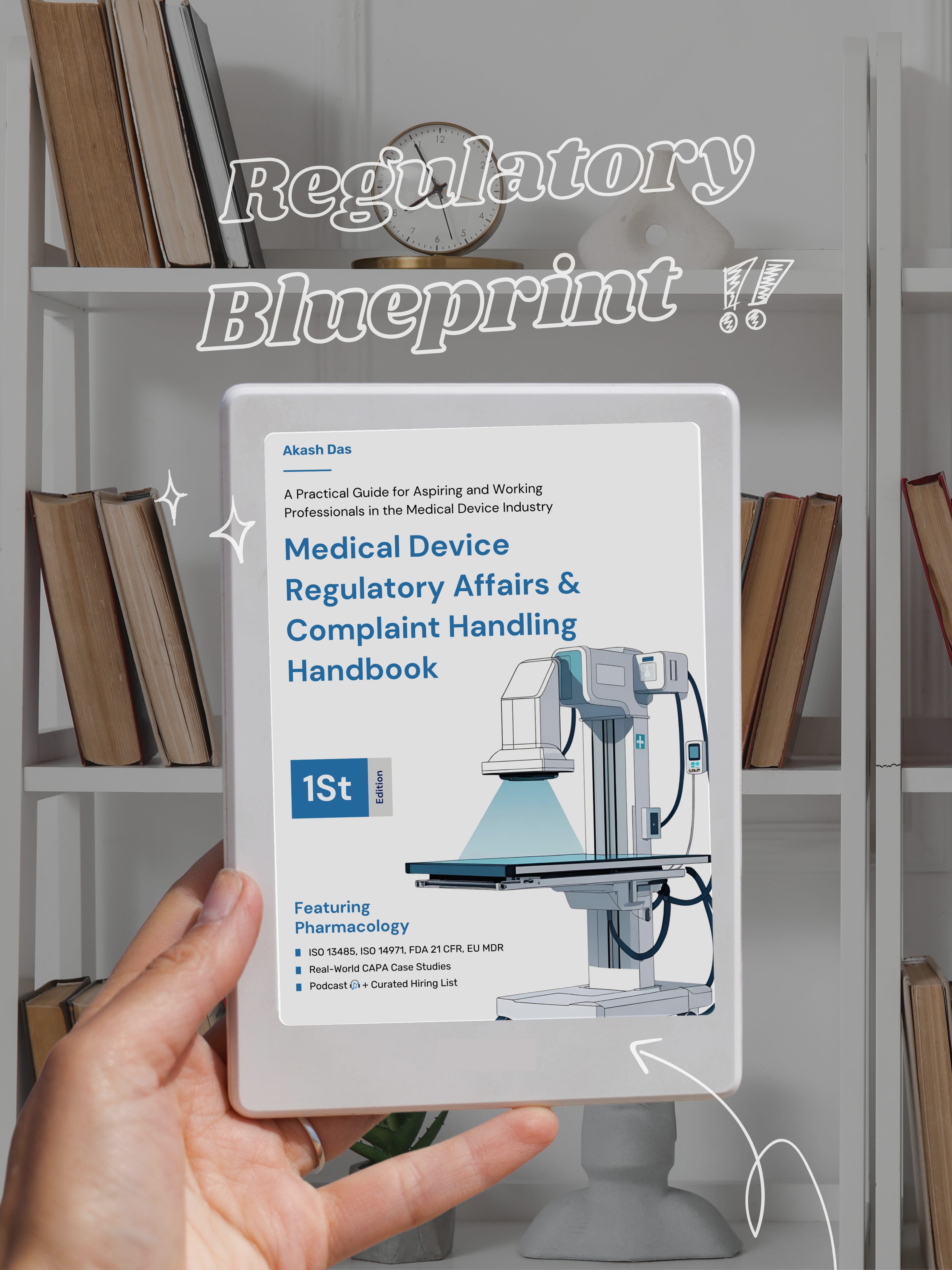
💬 DM me on WhatsApp to get your copy of the eBook.
Thanks for reading! Reply and tell me your worst audit finding story - let's learn from each other.
See you next Sunday ✨
– Akash Das
Let’s Connect on LinkedIn ☺️