Master EUMDR 2017/745 | Clinical Evaluation & PMCF (Article 61 & Annex XIV) | Your Complete 10-Week Implementation Guide.
Medical Device Insights - Issue #32 April 12, 2026

Hi There, 👋
Welcome to Week 4 of our EU MDR Mastery series! This is the topic most companies struggle with: Clinical Evaluation. MDR raised the bar significantly - equivalence is restricted, clinical data must be robust, and PMCF is mandatory.

Why this series?
EU MDR 2017/745 is mandatory for all medical devices sold in Europe. It’s the difference between market access and market exclusion, between CE marking and certification denial, between EU competitiveness.
📚 Series Progress: EU MDR Mastery
✅ Issue #29: EU MDR Introduction & Overview
✅ Issue #30: General Safety & Performance Requirements (Annex I)
✅ Issue #31: Technical Documentation (Annex II & III)
📍 Issue #32 (Today): Clinical Evaluation & PMCF
⬜ Issue #33: Conformity Assessment & Notified Bodies
⬜ Issue #34: UDI, Registration & EUDAMED
⬜ Issue #35: Economic Operators & Responsibilities
⬜ Issue #36: Post-Market Surveillance & Vigilance
⬜ Issue #37: Quality Management & Risk Management
⬜ Issue #38: Implementation Roadmap & Practical Guidance
📌 Clinical Evaluation: The Heart of MDR Compliance
What Article 61 requires:
“Manufacturers shall demonstrate conformity with the general safety and performance requirements... by generating sufficient clinical evidence through: (a) Clinical investigation, OR (b) A clinical evaluation of available clinical data and literature.”
Translation: You MUST have robust clinical evidence showing your device is safe and performs as intended.
The reality:
This is the #1 reason for MDR submission delays.
Notified Bodies reject weak clinical evaluations.
Many devices are stuck because inadequate clinical evidence.
PMCF is now mandatory (not optional).
🎯 What is Clinical Evaluation?
Definition (Article 2(44)):
“A systematic and planned process to continuously generate, collect, analyze, and assess clinical data pertaining to a device in order to verify the safety and performance, including clinical benefits, of the device when used as intended by the manufacturer.”
Key words:
Systematic: Structured methodology, not ad hoc.
Planned: Pre-defined in Clinical Evaluation Plan.
Continuous: Throughout the device lifecycle, not one-time.
Generate, collect, analyze, assess: Active process.
🎯 Clinical Evaluation vs Clinical Investigation
Common confusion - these are NOT the same:
Clinical Evaluation:
Systematic assessment of ALL clinical data.
Includes literature, clinical investigations, PMCF, registries, etc.
Documented in Clinical Evaluation Report (CER).
Required for ALL devices.
Clinical Investigation:
Prospective study conducted on human subjects.
Generates NEW clinical data.
Follows Clinical Investigation Plan.
Requires ethics committee approval.
Required ONLY when existing data is insufficient.
Relationship:
Clinical Evaluation (broader)
    ├── Literature review
    ├── Equivalence data (if claimed)
    ├── Clinical investigation data (if performed)
    └── Post-market clinical follow-up (PMCF)
🎯 The Clinical Evaluation Process
Step-by-step methodology (per MEDDEV 2.7/1 Rev 4):
Stage 0: Planning
Define scope.
Identify applicable requirements.
Create Clinical Evaluation Plan (CEP).
Stage 1: Identification of data
Literature search.
Clinical investigation data.
PMCF data.
Other clinical experience.
Stage 2: Appraisal of data
Assess quality and relevance.
Weight of evidence.
Equivalence assessment (if applicable).
Stage 3: Analysis of data
Benefit-risk analysis.
Acceptability of risks
Undesirable side effects.
Comparison to the state of the art.
Stage 4: Conclusions
Is clinical evidence sufficient?
Is the benefit-risk favorable?
What are residual uncertainties?
What does PMCF need?
🎯 Clinical Evaluation Plan (CEP)
What is CEP?
Document that defines:
Scope of clinical evaluation
Clinical background
Methods to be used
Literature search strategy
Appraisal criteria
Analysis approach
Timeline
When created: BEFORE clinical evaluation starts
Think of CEP as: Your roadmap - it guides the entire clinical evaluation process
CEP Contents:
1. Device identification and description
Name, model, version.
Intended purpose.
Indications, contraindications.
Patient population.
Clinical benefits claimed.
2. Scope of clinical evaluation
Intended use.
Claims to be supported.
Specific clinical questions to answer.
3. Clinical background
Medical condition and patient population.
Current treatment options.
State of the art.
Clinical need for the device.
4. Methods
Literature search:
Search strategy (databases, keywords).
Inclusion/exclusion criteria.
Time period covered.
Clinical investigation:
If needed, reference to Clinical Investigation Plan.
If not needed, rationale.
Equivalence:
If claiming equivalence, to which device?
Rationale for equivalence claim.
PMCF:
PMCF methods planned.
Data to be collected.
5. Appraisal criteria
How will data quality be assessed?
How will relevance be determined?
What constitutes sufficient evidence?
6. Analysis approach
How will the benefit-to-risk be assessed?
Statistical methods (if applicable).
Comparison to alternatives.
7. Schedule
Timelines for literature search, appraisal, and analysis.
Update frequency (at least annually)
🎯 Literature Search - The Foundation
Why literature search critical?
MDR requires a systematic literature review to:
Identify clinical data on your device.
Identify data on equivalent/similar devices.
Understand the state of the art.
Identify known risks and benefits.
Support claims.
How to conduct a systematic literature search:
1. Define search strategy
Databases to search:
MEDLINE/PubMed
EMBASE
Cochrane Library
Device-specific databases
Regulatory databases (MAUDE, NANDO)
Search terms:
Device-specific terms
Medical condition terms
Procedure terms
Synonyms and variants
Example search string: “(infusion pump OR IV pump OR intravenous pump) AND (safety OR adverse events OR complications OR performance).”
Time period:
Typically last 5-10 years.
Older if seminal studies.
Justify the time period selected.
Inclusion criteria:
Relevant to device/indication.
Human studies.
Published in peer-reviewed journals.
Adequate quality.
Exclusion criteria:
Animal studies
In vitro only
Case reports (unless specific safety issue)
Poor quality/inadequate methods
2. Conduct a search
Document:
Date of search
Databases searched
Search strings used
Number of results
Example: “Search conducted March 15, 2026, in PubMed using search string above. Results: 487 citations identified.”
3. Screen results
Two-stage screening:
Stage 1: Title/abstract screening
Apply inclusion/exclusion criteria
Document number retained
Example: “Title/abstract screening: 487 citations → 67 retained for full-text review.”
Stage 2: Full-text screening
Review full papers
Final inclusion/exclusion
Document reasons for exclusion
Example: “Full-text review: 67 papers → 23 included in clinical evaluation (44 excluded: 15 not relevant indication, 12 poor quality, 10 animal studies, 7 duplicates)”
4. Extract and appraise data
For each included study:
Extract:
Study design (RCT, cohort, case series, etc.)
Sample size
Patient population
Device details
Outcomes measured
Results
Conclusions
Appraise quality:
Risk of bias
Study limitations
Relevance to your device
Quality assessment tools:
GRADE for overall evidence quality
Cochrane Risk of Bias tool
Newcastle-Ottawa Scale
Custom appraisal criteria per CEP
5. Synthesize evidence
Create an evidence table:
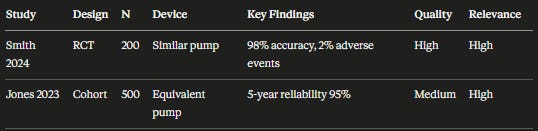
Narrative synthesis:
Overall body of evidence
Consistency of findings
Gaps in evidence
Applicability to your device
🎯 Equivalence - The Controversial Topic
What changed under MDR:
MDD: Equivalence is widely accepted, and often a weak justification is sufficient.
MDR: Equivalence HIGHLY restricted, strict criteria.
When equivalence allowed:
Article 61(5): Equivalence can be claimed ONLY IF the equivalent device:
Same manufacturer OR
The manufacturer provides full access to technical documentation
AND all these conditions met:
Technical equivalence:
Same clinical/technical characteristics
Same specifications and properties (including physicochemical)
Same materials
Same design characteristics
Biological equivalence:
Same materials or substances in contact with the same human tissues/body fluids.
Clinical equivalence:
Same clinical performance.
Same intended purpose, indication.
Same duration and frequency of use.
Same kind and degree of invasiveness.
Same patient population (including age, anatomy, physiology).
Same relevant critical performance.
Practically: Equivalence is VERY difficult to demonstrate under MDR.
Demonstrating equivalence:
If claiming equivalence:
1. Identify the equivalent device clearly
Manufacturer, model, version.
How do you have access to technical documentation?
2. Create a detailed comparison table
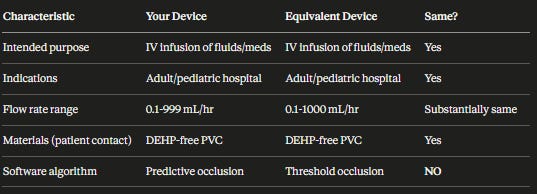
If ANY “NO” → Equivalence claim weak or invalid
3. Justify differences
For any differences, demonstrate no impact on clinical performance or safety.
Provide data/rationale
4. Obtain clinical data on the equivalent device
Literature
Manufacturer’s clinical data (if access granted)
Post-market data
Reality: Most companies cannot fully demonstrate equivalence under MDR → Need to generate own clinical data
🎯 Clinical Investigation - When Needed
When is clinical investigation required?
Article 61(4): Clinical investigation needed if:
Implantable devices AND Class III devices:
Clinical investigation is the rule (unless justified otherwise).
All devices:
Existing data insufficient.
Equivalence cannot be demonstrated.
Novel devices/technology.
Significant questions about safety/performance.
Significant changes to the existing device.
Clinical Investigation Plan (CIP)
If conducting a clinical investigation:
Required per ISO 14155:
Study objectives
Study design (RCT, single-arm, registry, etc.)
Sample size justification
Inclusion/exclusion criteria
Endpoints (primary, secondary)
Statistical analysis plan
Safety monitoring
Ethical considerations
Regulatory pathway:
Ethics committee approval required
Competent authority notification
Sponsor responsibilities
Informed consent
Monitoring and auditing
🎯 Post-Market Clinical Follow-up (PMCF)
What is PMCF?
Article 2(60):
“A continuous process that updates the clinical evaluation... by gathering, assessing, and analyzing clinical data from the use of a device that has been placed on the market.”
Key change under MDR:
MDD: PMCF optional
MDR: PMCF MANDATORY for most devices
Why is PMCF required?
Confirm safety and performance in real-world use
Clinical trials often have a limited sample size, duration, and population.
Real-world use reveals issues not seen in trials.
Identify emerging risks
Long-term effects.
Rare adverse events.
Use in broader populations.
Monitor benefit-risk over time
Does the benefit-to-risk ratio remain favorable?
How does the device compare to the evolving state of the art?
Address residual uncertainties
Questions not answered by pre-market data.
Specific populations (pediatric, elderly, comorbidities).
PMCF Plan
Required document defining:
1. PMCF objectives
What questions to answer?
What uncertainties to address?
Example objectives:
Confirm safety profile in broader population
Monitor long-term performance (5+ years)
Evaluate performance in the pediatric subgroup
Compare outcomes to alternative treatments
2. PMCF methods
Options include:
Proactive methods:
PMCF studies (prospective)
Registries
Surveys
Specific monitoring programs
Reactive methods:
Complaint analysis
Literature monitoring
Adverse event analysis
Returned product analysis
Example PMCF study: “Prospective observational registry of 500 patients using device for 5 years. Primary endpoint: device-related adverse events. Secondary endpoints: device performance, patient satisfaction, comparison to historical controls.”
3. Data to be collected
Clinical outcomes
Adverse events
Device performance
User feedback
Comparison data
4. Success criteria
When is PMCF objective met?
Acceptable event rates
Performance thresholds
5. Analysis plan
How will data be analyzed?
Statistical methods
Comparison groups
6. Reporting
How often PMCF reviewed?
How findings integrated into clinical evaluation?
Triggers for action
PMCF Evaluation Report
Periodically (at least with PSUR):
Document:
PMCF activities conducted
Data collected
Analysis results
Impact on clinical evaluation
Impact on benefit-risk
Actions taken (if any)
Updates to the PMCF plan
🎯 Clinical Evaluation Report (CER)
The key deliverable:
CER is the comprehensive document demonstrating adequate clinical evidence.
Think of CER as: The story of your clinical evidence - from planning through conclusions
CER Structure (per MEDDEV 2.7/1 Rev 4):
1. Summary and Conclusions
Executive summary
Overall conclusions
Recommendations
2. Scope and Context
Device description
Intended purpose
Claims
Clinical background
3. Clinical Development and Evaluation Planning
Reference to Clinical Evaluation Plan
Methods used
4. Device Under Evaluation and Scope
Detailed device description
Variants/configurations
Intended use and claims
Previous generations (if applicable)
5. Scientific Validity Check
Literature search methodology
Search results
Data sources
6. Data Appraisal
For each data source:
Description
Quality assessment
Relevance assessment
Weight of evidence
Data from:
Clinical investigations
Literature
Equivalence device (if applicable)
PMCF
Complaints/vigilance
Other sources
7. Data Analysis
Clinical benefits:
What are the clinical benefits?
Evidence supporting benefits
Magnitude of benefits
Clinical safety:
What are the risks?
Frequency and severity
Mitigation measures
Residual risks
Benefit-risk analysis:
Do benefits outweigh risks?
For which patient populations?
Comparison to alternatives
Comparison to state of the art:
How does the device compare to the current standard?
Advantages/disadvantages
Undesirable side effects:
What side effects were observed?
Frequency, severity, duration
Acceptability
8. Conclusions
Is clinical evidence sufficient?
Sufficient to demonstrate safety?
Sufficient to demonstrate performance?
Sufficient to demonstrate clinical benefit?
Sufficient to support benefit-risk?
Are there gaps?
What uncertainties remain?
What additional data is needed?
PMCF requirements:
What did PMCF need to address the gaps?
PMCF plan adequate?
Overall conclusion:
Is the benefit-risk favorable?
Are GSPR met?
Can the device be placed on the market?
CER Quality Criteria:
Good CER characteristics:
Systematic and transparent
All data sources identified
Quality and relevance assessed
Comprehensive benefit-risk analysis
Clear conclusions
Identifies gaps and PMCF needs
References all supporting documents
Traceable to technical documentation
Poor CER characteristics:
Generic, copy-paste from template
Literature search inadequate
Equivalence claimed without justification
Benefits/risks not quantified
Gaps not acknowledged
No PMCF plan or weak PMCF
Conclusions not supported by data
🎯 Clinical Evidence by Device Class
Class I (non-sterile, non-measuring):
Requirements:
Clinical evaluation required
Often literature-based sufficient
PMCF recommended, but may be passive (complaint monitoring)
Example: “Tongue depressor: Literature shows wooden tongue depressors are safe and effective. PMCF through complaint monitoring.”
Class I (sterile, measuring, reusable surgical):
Requirements:
More rigorous clinical evaluation.
Literature is typically sufficient if the device is well-established.
PMCF plan required.
Class IIa:
Requirements:
Robust clinical evaluation.
Literature may be sufficient if similar devices are well-documented.
Equivalence may support (if criteria met).
PMCF plan required (may include proactive PMCF study).
Example: “Blood pressure monitor: Literature on similar monitors + own performance validation data + PMCF registry study.”
Class IIb:
Requirements:
Extensive clinical evaluation.
Literature alone usually insufficient.
Own clinical data is often needed.
PMCF plan is required with a proactive PMCF study.
Example: “Infusion pump: Literature review + clinical investigation (100 patients) + ongoing PMCF registry (500 patients).”
Class III:
Requirements:
Most rigorous clinical evaluation.
Clinical investigation is typically required (unless a strong justification).
Comprehensive long-term data needed.
PMCF plan required with extensive proactive PMCF.
Example: “Heart valve: Pivotal clinical trial (300 patients, 5-year follow-up) + literature on similar valves + ongoing PMCF registry (1000 patients, 10-year follow-up).”
Implantable devices:
Additional requirements:
Clinical investigation is the rule.
Long-term follow-up essential.
PMCF with extended duration.
Implant card with patient information.
📊 Series Tracker
✅ Issue #29: EU MDR Introduction & Overview
✅ Issue #30: General Safety & Performance Requirements
✅ Issue #31: Technical Documentation
✅ Issue #32: Clinical Evaluation & PMCF (Today!)
⬜ Issue #33: Conformity Assessment & Notified Bodies
⬜ Issue #34: UDI, Registration & EUDAMED
⬜ Issue #35: Economic Operators & Responsibilities
⬜ Issue #36: Post-Market Surveillance & Vigilance
⬜ Issue #37: Quality Management & Risk Management
⬜ Issue #38: Implementation Roadmap
👉 Master PMS Interview Topics
This question trips up candidates because it combines multiple expertise areas:
✅ FDA 21 CFR
✅ EU MDR
✅ ISO 13485
✅ ISO 14971
✅ CAPA & Complaint Handling
✅ Real Case Sudies + Dumy Audit Preperation + Free Podcase
Options:
🟦 eBook only – ₹199
🟥 Live Class + Free eBook – ₹149/hr
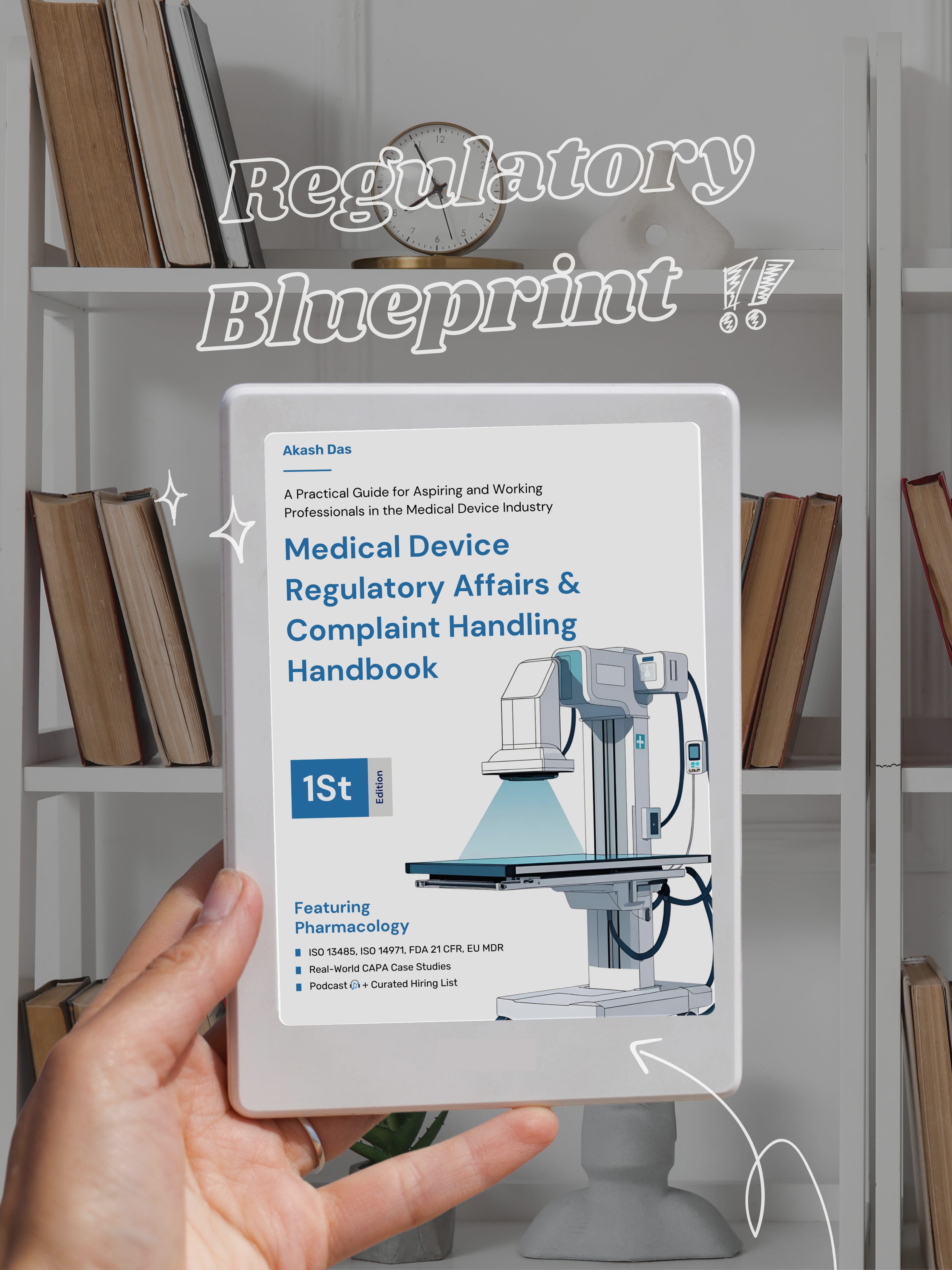
💬 DM me on WhatsApp to get your copy of the eBook.
Thanks for reading! Reply and tell me your worst audit finding story - let's learn from each other.
See you next Sunday ✨
– Akash Das
Let’s Connect on LinkedIn ☺️