Master EUMDR 2017/745 | Conformity Assessment & Notified Bodies | Your Complete 10-Week Implementation Guide.
Medical Device Insights - Issue #33 April 19, 2026

Hi There, 👋
Welcome to Week 5 of our EU MDR Mastery series! You've prepared your technical documentation and clinical evidence. Now comes the conformity assessment - the formal process to achieve CE marking. This week: understanding assessment routes, selecting a Notified Body, and what they scrutinize in audits.

Why this series?
EU MDR 2017/745 is mandatory for all medical devices sold in Europe. It’s the difference between market access and market exclusion, between CE marking and certification denial, between EU competitiveness.
📚 Series Progress: EU MDR Mastery
✅ Issue #29: EU MDR Introduction & Overview
✅ Issue #30: General Safety & Performance Requirements (Annex I)
✅ Issue #31: Technical Documentation (Annex II & III)
✅ Issue #32: Clinical Evaluation & PMCF
📍 Issue #33 (Today): Conformity Assessment & Notified Bodies
⬜ Issue #34: UDI, Registration & EUDAMED
⬜ Issue #35: Economic Operators & Responsibilities
⬜ Issue #36: Post-Market Surveillance & Vigilance
⬜ Issue #37: Quality Management & Risk Management
⬜ Issue #38: Implementation Roadmap & Practical Guidance
📌 Conformity Assessment: The Path to CE Marking
What is conformity assessment?
The formal process to demonstrate your device meets ALL applicable MDR requirements.
Why it matters:
No conformity assessment = No CE marking
No CE marking = No EU market access
Wrong route selected = Delays and rejections
Wrong Notified Body = Application stuck
The reality in 2026:
Notified Body capacity still constrained.
Wait times: 12-24 months for initial assessment.
Rigorous scrutiny of technical documentation.
High rejection rates for inadequate submissions.
🎯 Conformity Assessment Routes by Device Class
Article 52: Conformity assessment procedures
Different routes depending on device classification:
Class I (non-sterile, non-measuring, non-reusable surgical)
Route: Self-certification (no Notified Body needed)
Process:
The manufacturer prepares technical documentation (Annex II or III).
The manufacturer conducts a clinical evaluation.
The manufacturer establishes a QMS.
The manufacturer draws up the EU Declaration of Conformity.
The manufacturer affixes the CE marking.
The manufacturer registers the device in EUDAMED.
Key point: Self-certification does NOT mean no requirements - ALL MDR requirements still apply, the manufacturer just doesn’t need NB approval.
Manufacturer responsibility:
Full compliance with MDR.
Complete technical documentation.
Available for competent authority inspection.
Face penalties if non-compliant.
Class I (sterile, measuring function, reusable surgical)
Route: Limited Notified Body involvement
Options:
For sterile devices:
Annex IX Chapter I (QMS audit by NB - sterile aspects only), OR
Annex II Section 2 (NB review of technical documentation on sterilization)
For measuring devices:
Annex IX Chapter I (QMS audit - measurement aspects), OR
Annex II Section 3 (NB review of technical documentation on measurement)
For reusable surgical instruments:
Annex IX Chapter I (QMS audit - reprocessing aspects), OR
Annex II Section 4 (NB review of technical documentation on reprocessing)
Process:
The manufacturer prepares full technical documentation.
NB assesses specific aspects (sterility/measurement/reprocessing).
NB issues a certificate for assessed aspects.
The manufacturer completes the declaration of Conformity.
The manufacturer affixes the CE marking.
Class IIa
Routes available:
Route 1: Annex IX + Annex X
Full QMS assessment (Annex IX)
PLUS Type examination (Annex X) for representative device
Route 2: Annex IX + Annex XI
Full QMS assessment (Annex IX)
PLUS Product conformity verification (Annex XI)
Most common for IIa: Route 1 (QMS + Type examination).
Class IIb
Routes available (same as IIa):
Route 1: Annex IX + Annex X
Full QMS assessment
PLUS Type examination
Route 2: Annex IX + Annex XI
Full QMS assessment
PLUS Product conformity verification
Difference from IIa: More rigorous NB scrutiny, more extensive documentation review.
Class III
Routes available:
Route 1: Annex IX + Annex X (most common)
Full QMS assessment.
PLUS Type examination with design dossier review.
Route 2: Annex IX + Annex XI
Full QMS assessment.
PLUS Product conformity verification.
Additional requirement for certain Class III:
Consultation procedure with an expert panel or a reference laboratory.
Devices incorporating medicinal substances.
Devices manufactured using non-viable animal tissues/derivatives.
Other devices the commission identifies.
Difference from IIa/IIb:
Most stringent NB scrutiny.
Often, a clinical investigation is required.
A consultation procedure may be needed.
Longer timelines.
🎯 Understanding the Annexes
Annex IX: QMS Assessment + Technical Documentation
What it covers:
Part A: Full QMS assessment based on:
ISO 13485
PLUS MDR-specific requirements.
NB audits your QMS covering:
Management responsibility.
Resource management.
Product realization (design, purchasing, production).
Measurement, analysis, improvement.
PLUS MDR requirements (PRRC, PMS, vigilance, etc.).
Part B: Assessment of technical documentation.
For representative devices, NB reviews:
Device description.
Design and manufacturing information.
GSPR compliance demonstration.
Benefit-risk analysis.
Risk management file.
Clinical evaluation.
Verification/validation data.
Labeling and IFU.
Certificate issued: QMS + technical documentation certificate (valid 5 years).
Annex X: Type Examination
What it covers:
NB examines:
Design and construction of a representative device.
Technical documentation.
Verification/validation evidence.
Clinical evaluation.
Compliance with GSPR.
Certificate issued: EU Type-Examination Certificate (valid 5 years)
After the certificate: The manufacturer produces devices in conformity with the approved type.
Annex XI: Product Conformity Verification
What it covers:
NB verifies conformity through:
Examination of each manufactured device, OR
Statistical verification of batches, OR
Verification on a representative basis.
Used less commonly than Annex X
🎯 The Notified Body Landscape
What is a Notified Body?
Definition: A conformity assessment body designated by an EU Member State to conduct a third-party assessment under MDR.
Current situation (2026):
~40 Notified Bodies designated for MDR (vs ~80 under MDD).
Stricter designation requirements.
Enhanced oversight by the EU Commission.
Capacity constraints = long wait times.
NB Designation Requirements
Under MDR, NBs must demonstrate:
Organizational requirements:
Legal entity.
Independent of manufacturers.
No conflicts of interest.
Adequate liability insurance.
Personnel requirements:
Qualified technical experts.
Clinical evaluators.
Auditors with medical device expertise.
Ongoing training programs.
Quality management:
ISO/IEC 17021 (QMS certification bodies)
ISO/IEC 17065 (product certification bodies)
Documented procedures
Internal audits
Competence:
Specific device expertise.
Clinical evaluation expertise.
Knowledge of standards and regulations.
Audit experience.
Oversight:
Joint assessment by Member State + EU Commission
Ongoing monitoring
Unannounced assessments
Performance indicators
🎯 Selecting a Notified Body
Critical decision factors:
1. Scope of designation
Not all NBs cover all device types!
Check NB scope covers:
Your device class.
Your device type.
Your technology.
Your medical specialty.
Example:
NB may cover Class III cardiovascular, but NOT Class III orthopedic.
NB may cover active devices, but NOT implants.
Where to check: NANDO database (ec.europa.eu/growth/tools-databases/nando).
2. Experience with your device type
Prefer NBs with:
Track record in your device category.
Technical experts in your field.
Understanding of your technology.
Clinical evaluators with a relevant specialty.
How to assess:
Ask for references.
Check EUDAMED for their certificates.
Talk to companies they’ve certified.
Review their technical expertise list.
3. Capacity and timelines
Ask potential NBs:
Current application backlog?
Estimated timeline for initial assessment?
Timeline for certificate issuance?
Resources dedicated to your project?
Reality check:
12-18 months initial assessment.
18-24 months if clinical data is weak.
Some NBs are not accepting new clients.
4. Geographic considerations
Think about:
Language capabilities (English sufficient? Your language?)
Location for on-site audits
Time zone for communication
Travel costs
Not critical but helpful:
NB in the same country.
Same language.
Familiar with your market.
5. Fees and costs
NB fees vary widely:
Application fees: €5,000 - €20,000
Assessment fees (total):
Class IIa: €25,000 - €60,000
Class IIb: €40,000 - €100,000
Class III: €80,000 - €200,000+
Annual surveillance: €10,000 - €40,000/year
Factors affecting cost:
Device complexity.
Number of variants.
Quality of documentation.
Need for additional review rounds.
Get detailed quotes from multiple NBs.
6. Relationship and communication
Evaluate:
Responsiveness to inquiries.
Clarity of communication.
Willingness to provide guidance.
Cultural fit.
Support during preparation.
This is a long-term relationship (5+ years minimum).
Selection process:
Step 1: Identify NBs with appropriate scope (NANDO database).
Step 2: Narrow to 3-5 candidates with relevant experience.
Step 3: Request information package:
Scope of services
Process and timelines
Fee structure
References
Step 4: Conduct interviews/meetings with the top 2-3.
Step 5: Make a decision based on:
Technical capability (weight: 40%)
Timeline/capacity (weight: 30%)
Cost (weight: 20%)
Relationship fit (weight: 10%)
Step 6: Engage selected NB, sign contract.
🎯 Maintaining Your Certificate
Certificate validity: 5 years
But requires:
Annual surveillance audits:
NB audits QMS annually.
Reviews technical documentation updates.
Checks post-market data.
Verifies corrective actions.
May expand the scope or sample different areas.
Updates for changes:
Significant changes require NB notification.
May require a new assessment.
The certificate may be updated or reissued.
PSUR review (Class IIb/III):
Periodic Safety Update Report submitted to NB.
NB reviews for safety signals.
May trigger additional scrutiny.
Continuous compliance:
Vigilance reporting.
PMS ongoing.
PMCF executed per plan.
Technical documentation kept current.
Failure to maintain:
The certificate can be suspended.
The certificate can be withdrawn.
Loss of CE marking.
Market withdrawal required.
✅ Conformity Assessment Checklist
Pre-Application:
Device classified correctly
Conformity assessment route selected
Notified Body identified (if needed)
Notified Body scope verified
Technical documentation complete
Clinical evaluation complete
QMS implemented (if NB assessment)
Internal readiness review conducted
Application:
Application forms completed.
📊 Series Tracker
✅ Issue #29: EU MDR Introduction & Overview
✅ Issue #30: General Safety & Performance Requirements
✅ Issue #31: Technical Documentation
✅ Issue #32: Clinical Evaluation & PMCF (Today!)
⬜ Issue #33: Conformity Assessment & Notified Bodies
⬜ Issue #34: UDI, Registration & EUDAMED
⬜ Issue #35: Economic Operators & Responsibilities
⬜ Issue #36: Post-Market Surveillance & Vigilance
⬜ Issue #37: Quality Management & Risk Management
⬜ Issue #38: Implementation Roadmap
👉 Master PMS Interview Topics
This question trips up candidates because it combines multiple expertise areas:
✅ FDA 21 CFR
✅ EU MDR
✅ ISO 13485
✅ ISO 14971
✅ CAPA & Complaint Handling
✅ Real Case Sudies + Dumy Audit Preperation + Free Podcase
Options:
🟦 eBook only – ₹199
🟥 Live Class + Free eBook – ₹149/hr
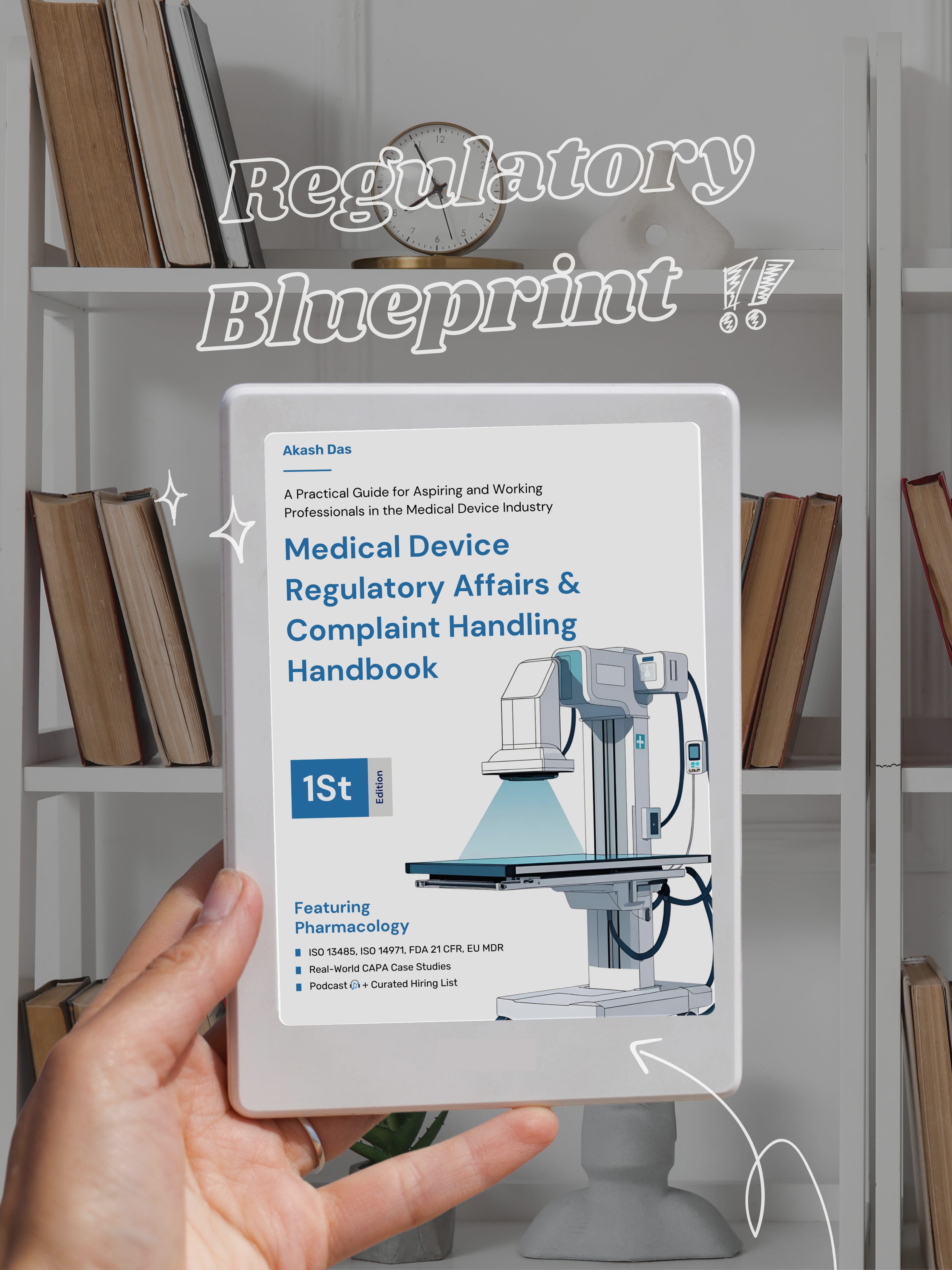
💬 DM me on WhatsApp to get your copy of the eBook.
Thanks for reading! Reply and tell me your worst audit finding story - let's learn from each other.
See you next Sunday ✨
– Akash Das
Let’s Connect on LinkedIn ☺️