Master EUMDR 2017/745 | Implementation Roadmap & Practical Guidance | Your Complete 10-Week Implementation Guide.
Medical Device Insights - Issue #38 May 24, 2026

Hi There, 👋
Welcome to the SERIES FINALE of our EU MDR Mastery series! Over 10 weeks, we’ve covered every critical aspect of EU MDR 2017/745. Today, we bring it ALL together with your complete implementation roadmap, practical timelines, and real-world guidance. Let’s finish strong!

📚 Series Complete: EU MDR Mastery
Your 10-week journey - COMPLETE!
✅ Issue #29: EU MDR Introduction & Overview
✅ Issue #30: General Safety & Performance Requirements (Annex I)
✅ Issue #31: Technical Documentation (Annex II & III)
✅ Issue #32: Clinical Evaluation & PMCF
✅ Issue #33: Conformity Assessment & Notified Bodies
✅ Issue #34: UDI, Registration & EUDAMED
✅ Issue #35: Economic Operators & Responsibilities
✅ Issue #36: Post-Market Surveillance & Vigilance
✅ Issue #37: Quality Management & Risk Management
✅ Issue #38 (Today): Implementation Roadmap & Practical Guidance - FINALE!
📌 Congratulations - You Made It!
Over 10 weeks, you’ve learned:
Complete EU MDR 2017/745 from introduction to implementation
Annex I GSPR - the foundation of compliance
Technical documentation requirements
Clinical evaluation and PMCF methodology
Notified Body selection and conformity assessment
UDI and EUDAMED digital infrastructure
Economic operator roles and responsibilities
Post-market surveillance and vigilance systems
QMS and risk management integration
You now have comprehensive knowledge of EU MDR compliance.
🎯 The Complete MDR Compliance Picture
Visual overview:
┌────────────────────────────────────────────────┐
│         EU MDR 2017/745 COMPLIANCE             │
├────────────────────────────────────────────────┤
│                                                │
│  PRE-MARKET                                    │
│  ├─ Design per Annex I (GSPR)                  │
│  ├─ Technical Documentation (Annex II/III)     │
│  ├─ Clinical Evaluation & PMCF Plan            │
│  ├─ Risk Management (ISO 14971)                │
│  ├─ QMS Implementation (ISO 13485 + MDR)       │
│  ├─ UDI Assignment                             │
│  ├─ EUDAMED Registration                       │
│  └─ Conformity Assessment (NB if applicable)   │
│                                                │
│  MARKET ENTRY                                  │
│  ├─ CE Marking                                 │
│  ├─ Declaration of Conformity                  │
│  └─ Device Registration in EUDAMED             │
│                                                │
│  POST-MARKET                                   │
│  ├─ Post-Market Surveillance                   │
│  ├─ PMCF Execution                             │
│  ├─ PMS Report / PSUR                          │
│  ├─ Vigilance (Serious Incidents)              │
│  ├─ Risk Management Updates                    │
│  └─ Clinical Evaluation Updates                │
│                                                │
└────────────────────────────────────────────────┘
🗺️ Your Complete Implementation Roadmap
Starting point: You have a medical device concept
Goal: CE-marked device on the EU market with ongoing compliance.
Timeline: 18-36 months (varies by device class and complexity).
📅 Phase 1: Foundation & Planning (Months 1-3)
Objectives:
Establish a compliance framework.
Classify the device correctly.
Build internal capability.
Create a project plan.
Month 1: Assessment & Classification
Week 1-2: Device Classification
Apply MDR Annex VIII classification rules.
Document classification rationale.
Identify applicable Annexes (I, II/III, XIV).
Determine conformity assessment route.
Assess the Notified Body's needs.
Week 3-4: Gap Analysis
Review current state (QMS, documentation, clinical evidence).
Compare against MDR requirements.
Identify gaps by category (technical, clinical, QMS, post-market).
Prioritize gaps by criticality.
Estimate resources needed.
Deliverable: Classification report, gap analysis document.
Month 2: Team & Infrastructure
Week 1-2: Build Team
Designate Person Responsible for Regulatory Compliance (PRRC).
Verify PRRC qualifications (education, experience per Article 15).
Assign project roles (technical documentation, clinical, QMS, regulatory).
Identify external resources needed (consultants, CRO, testing labs).
Engage with potential Notified Bodies (if Class IIa/IIb/III).
Week 3-4: Establish Systems
Document management system.
Quality management system (if not existing).
Risk management system.
Complaint handling system.
UDI issuing entity registration (GS1 or other).
Deliverable: Project team established, systems in place.
Month 3: Planning Documents
Week 1-2: Core Plans
Risk Management Plan (per ISO 14971).
Clinical Evaluation Plan (per Annex XIV).
Post-Market Surveillance Plan (per Article 84).
PMCF Plan (part of PMS Plan).
Week 3-4: Project Planning
Detailed project timeline.
Resource allocation.
Budget (development, testing, clinical, NB fees, registration).
Risk register (project risks).
Stakeholder communication plan.
Deliverable: All core plans documented and approved.
📅 Phase 2: Design & Development (Months 4-12)
Objectives:
Design device meeting Annex I requirements.
Generate technical documentation.
Conduct verification and validation.
Perform risk management.
Months 4-6: Design Phase
Design Inputs:
User needs identified.
Intended use defined.
Indications, contraindications, and warnings.
GSPR requirements translated to design requirements.
Risk management outputs inform design inputs.
Usability requirements defined.
Standards identified and applied.
Design Outputs:
Device specifications (functional, performance).
Design drawings, schematics, CAD files.
Software design documentation (if applicable, per IEC 62304).
Bill of materials.
Manufacturing specifications.
Labeling and IFU drafts.
Risk Management:
Hazard identification.
Risk analysis (FMEA or equivalent).
Risk evaluation against criteria.
Risk control measures identified.
Deliverable: Design outputs meeting design inputs, preliminary risk file.
Months 7-9: Verification Phase
Design Verification:
Verification plan and protocols.
Bench testing (functional, performance).
Electrical safety testing (IEC 60601-1 if applicable).
EMC testing (IEC 60601-1-2 if applicable).
Biocompatibility testing (ISO 10993 if applicable).
Software verification (IEC 62304 if applicable).
Sterilization validation (if sterile device).
Packaging validation.
Shelf life/stability testing.
Risk Management:
Verify risk control measures implemented.
Test the effectiveness of risk controls.
Evaluate residual risks.
Document verification results in the risk file.
Standards Compliance:
Test against all applicable harmonized standards.
Document compliance or justified deviations.
Deliverable: Verification reports, updated risk file.
Months 10-12: Validation Phase
Design Validation:
Validation plan.
Clinical validation (if applicable).
Usability validation (per IEC 62366).
Performance in simulated use.
User acceptance testing.
Clinical Evaluation:
Literature search conducted per CEP.
Data appraisal and analysis.
Equivalence assessment (if claiming).
Clinical investigation (if needed).
Benefit-risk analysis.
Clinical Evaluation Report (CER) drafted.
Risk Management:
Overall residual risk evaluation.
Benefit-risk determination.
Risk management report prepared.
Deliverable: Validation reports, Clinical Evaluation Report, Risk Management Report.
📅 Phase 3: Technical Documentation (Months 13-15)
Objectives:
Compile complete technical documentation.
Prepare for Notified Body submission (if applicable).
Ensure all gaps are closed.
Month 13: Documentation Compilation
Annex II Sections:
Section 1: Device Description and Specification (complete).
Section 2: Information Supplied by Manufacturer (labels, IFU finalized).
Section 3: Design and Manufacturing Information (complete design history).
Section 4: GSPR Compliance (point-by-point demonstration).
Section 5: Benefit-Risk and Risk Management (files complete).
Section 6: Verification and Validation (all reports compiled).
Supporting Documents:
Risk Management File (complete per ISO 14971).
Clinical Evaluation Report (per Annex XIV).
Post-Market Surveillance Plan.
PMCF Plan.
Test reports (all verification/validation).
Certificates of conformity (materials, components).
Month 14: Internal Review
Quality Checks:
Completeness review (all sections present).
Traceability verification (requirements → design → V&V).
GSPR compliance verification (each point addressed).
Clinical evidence adequacy review.
Risk management completeness.
Standards compliance verification.
Mock Audit:
Internal audit simulating NB review.
Cross-functional team review.
Identify and address gaps.
Prepare responses to anticipated questions.
Month 15: Finalization
Documentation Polish:
Address internal review findings.
Professional formatting.
Table of contents, indices.
Version control.
Approvals documented.
QMS Readiness:
QMS is implemented and operational.
Procedures followed and documented.
Records complete and organized.
Personnel trained.
Ready for QMS audit.
Deliverable: Complete technical documentation package, QMS audit-ready.
📅 Phase 4: Conformity Assessment (Months 16-24)
Objectives:
Obtain CE marking.
Complete regulatory requirements.
Prepare for market entry.
Month 16: Pre-Submission Activities
For Class I (self-certification):
Final technical documentation review.
Draw up the EU Declaration of Conformity.
Affix CE marking.
Proceed to Phase 5 (Registration & Launch).
For Class IIa/IIb/III (Notified Body required):
Notified Body Engagement:
Select Notified Body (if not already engaged).
Pre-submission meeting with NB.
Clarify NB expectations.
Confirm application requirements.
Agree on timeline.
UDI Implementation:
UDI-DI assigned.
UDI carrier designed and validated.
Labels updated with UDI.
Production systems generate UDI-PI.
Months 17-18: NB Application & Initial Review
Application Submission:
Application forms completed.
Technical documentation submitted (electronic).
Application fee paid.
Submission acknowledged by NB.
NB Completeness Review:
NB reviews for completeness (2-4 weeks).
Respond to initial questions.
Provide additional information if requested.
Completeness confirmed.
QMS Audit Scheduling:
QMS audit date scheduled (if Annex IX route).
Prepare audit logistics.
Prepare personnel for interviews.
Review procedures and records.
Months 19-21: NB Technical Review & QMS Audit
Technical Documentation Review:
NB reviews technical documentation in detail.
Responds to NB questions (typically multiple rounds).
Provides clarifications and additional data.
Addresses NB concerns.
Focus areas NB scrutinizes:
Clinical evaluation (most scrutiny).
Risk management completeness.
Standards compliance.
Benefit-risk analysis.
GSPR compliance demonstration.
QMS Audit:
On-site QMS audit conducted.
NB audits per ISO 13485 + MDR requirements.
Non-conformities identified.
Corrective actions planned.
Post-Audit:
Address non-conformities.
Provide evidence of corrections.
Follow-up audit if needed (for major NCs).
Months 22-24: Final Review & Certificate Issuance
Final NB Review:
NB reviews all responses.
Confirms non-conformities closed.
Reviews final documentation version.
Internal NB approval process.
Certificate Issuance:
NB issues certificate (Annex IX + X or IX + XI).
Certificate received and verified.
Certificate uploaded to EUDAMED (by NB).
Declaration of Conformity:
Draw up EU Declaration of Conformity (Annex IV).
Reference NB certificate.
Signed by an authorized person.
Made available to authorities.
CE Marking:
Affix CE marking + NB identification number.
On device and packaging per requirements.
Deliverable: CE certificate, Declaration of Conformity, CE marked device.
Note: Timeline varies:
Class IIa: 12-18 months typical
Class IIb: 15-20 months typical
Class III: 18-24+ months typical
📅 Phase 5: Registration & Market Launch (Month 25)
Objectives:
Complete all registrations.
Launch device on the market.
Establish post-market systems.
Week 1-2: EUDAMED Registration
Actor Registration (Module 1):
Register as an economic operator (if not already).
Obtain Single Registration Number (SRN).
SRN included in Declaration of Conformity.
Device Registration (Module 2):
Register device with Basic UDI-DI.
Complete all required data fields.
Upload clinical evaluation summary (5000 characters).
Reference certificate (if NB involved).
Specify countries where the device is available.
Submission confirmed.
Verification:
Device searchable in EUDAMED public interface.
Information accurate and complete.
Week 3: Supply Chain Preparation
If Non-EU Manufacturer:
Authorized Representative appointed and registered.
Written mandate in place.
Auth Rep has access to documentation.
Distribution Channels:
Importers identified and registered (Module 1).
Distributors informed of requirements.
Supply agreements include UDI and traceability requirements.
Economic operator traceability established.
Labeling & Packaging:
Final labels with CE marking, UDI.
IFU in official EU languages.
Packaging meets transport/storage requirements.
Week 4: Launch
Market Introduction:
First devices placed on the market.
Traceability records initiated (who supplied, who supplied to).
Commercial activities begin.
Customer training (if applicable).
Communication:
Customers informed of device availability.
Healthcare professionals are provided with information.
Marketing materials compliant (no misleading claims).
Deliverable: Device on the EU market with full compliance.
📅 Phase 6: Post-Market Operations (Ongoing)
Objectives:
Maintain compliance.
Monitor safety and performance.
Continuous improvement.
Continuous Activities:
Post-Market Surveillance:
Data collection per PMS Plan (daily/weekly)
Complaints
Returns
Service reports
Literature
Regulatory databases
Data analysis (monthly)
Trends
Patterns
Statistical analysis
PMS Reviews (quarterly minimum)
Evaluate findings
Identify actions needed
Document decisions
PMS Report / PSUR (annually or per class requirements)
Class I: PMS Report when tech doc updated
Class IIa/IIb: PSUR every 2 years (first within 1 year)
Class III/Implants: PSUR annually
Submit to Notified Body via EUDAMED
PMCF Execution:
PMCF studies conducted per plan.
Data collected and analyzed.
PMCF evaluation reports prepared.
Clinical evaluation updated with PMCF findings.
Vigilance:
Serious incidents identified and reported (2/10 day timelines).
Investigations conducted.
Root causes determined.
Corrective actions implemented.
Field Safety Corrective Actions (FSCA) when needed.
Field Safety Notices (FSN) distributed.
Trend reports submitted if applicable.
Risk Management:
Post-production information reviewed.
Risk management updated based on field data.
New hazards identified and addressed.
Benefit-risk reassessed.
Clinical Evaluation:
CER is updated at least annually.
Literature search refreshed.
Post-market data incorporated.
Benefit-risk conclusions updated.
QMS Maintenance:
Internal audits (at least annually).
Management reviews (at least annually).
CAPA system operating.
Training conducted.
Document control maintained.
Notified Body Surveillance:
Annual surveillance audits (for NB-certified devices).
Unannounced audits (Class III: at least every 2 years).
Changes notified to NB.
PSUR submitted to NB.
Certificate renewals (every 5 years).
EUDAMED Maintenance:
Device information updated within 1 week of changes.
Vigilance reports submitted.
Registration kept current.
🎯 Realistic Timeline Expectations
By Device Class:
Class I (non-sterile, non-measuring):
12-18 months from concept to market.
Self-certification.
Shorter if simple device, existing manufacturer.
Class IIa:
18-24 months from concept to market.
NB involvement adds 12-18 months.
Clinical evaluation key variable.
Class IIb:
24-30 months from concept to market.
More rigorous NB scrutiny.
Clinical evidence often requires one's own data.
Class III:
30-36+ months from concept to market.
Most stringent requirements.
Clinical investigation is often needed.
Consultation procedure may apply.
Variables affecting timeline:
Device complexity
Clinical evidence availability.
Novel technology vs well-established.
Manufacturer experience.
Quality of initial submission.
NB workload and responsiveness.
💰 Budget Considerations
Typical Costs (Approximate):
Development & Testing:
Design & engineering: €50,000 - €500,000+
Verification testing: €20,000 - €100,000
Biocompatibility testing: €10,000 - €50,000
Clinical investigation (if needed): €100,000 - €1,000,000+
Usability testing: €10,000 - €50,000
Regulatory & Compliance:
QMS implementation/consultant: €20,000 - €100,000
Technical documentation preparation: €30,000 - €150,000
Clinical evaluation (CER): €10,000 - €50,000
Regulatory consultant: €30,000 - €100,000/year
Notified Body (Class IIa/IIb/III):
Application fee: €5,000 - €20,000
Initial assessment: €25,000 - €200,000 (varies by class)
Annual surveillance: €10,000 - €40,000/year
Certificate renewal (every 5 years): €20,000 - €100,000
UDI & EUDAMED:
UDI issuing entity (GS1): €1,000 - €5,000/year
EUDAMED registration: No direct fee (but internal resource cost)
Authorized Representative (if non-EU):
€5,000 - €25,000/year
Post-Market:
PMS activities: €10,000 - €50,000/year
PMCF studies: €20,000 - €200,000 (depending on scope)
Vigilance system: Included in QMS but resource cost
Total estimated costs:
Class I: €100,000 - €300,000
Class IIa: €200,000 - €500,000
Class IIb: €300,000 - €800,000
Class III: €500,000 - €2,000,000+
Note: Costs highly variable based on device, manufacturer capabilities, outsourcing vs in-house
🚨 Common Implementation Pitfalls
Pitfall #1: Underestimating clinical evidence requirements
Problem: Assume equivalence will work, but can’t demonstrate per MDR strict criteria
Impact: Major delays finding clinical data, may need expensive clinical investigation
Avoidance: Assess clinical evidence needs early, start PMCF or clinical investigation early if needed
Pitfall #2: Late Notified Body engagement
Problem: Contact NB only when ready to submit, but NB has 12+ month backlog
Impact: Market entry delayed 12-24 months
Avoidance: Engage NB 18-24 months before target launch, build relationship early
Pitfall #3: Inadequate resource allocation
Problem: Underestimate time/cost, especially for PRRC, clinical evaluation, PMS
Impact: Quality suffers, submissions rejected, compliance gaps
Avoidance: Realistic budgeting, allocate sufficient qualified resources, plan for contingencies
Pitfall #4: Documentation quality issues
Problem: Technical documentation incomplete, inconsistent, poorly organized
Impact: NB rejects or requires extensive rework, multiple review rounds, delays
Avoidance: Internal reviews before submission, professional documentation, traceability throughout
Pitfall #5: Treating post-market as an afterthought
Problem: Focus only on pre-market, minimal PMS/PMCF planning.
Impact: NB rejects weak PMS/PMCF plans, compliance failures post-launch, and certificate suspension.
Avoidance: Robust PMS/PMCF plans from the start, allocate post-market resources, and establish systems before launch.
🎉 You Did It - Series Complete!
What you’ve accomplished over 10 weeks:
Knowledge Gained:
✅ Complete EU MDR 2017/745 regulation.
✅ Annex I GSPR (23 sections).
✅ Technical documentation requirements (Annex II/III).
✅ Clinical evaluation methodology (Annex XIV).
✅ Conformity assessment routes and NB selection.
✅ UDI system and EUDAMED navigation.
✅ Economic operator responsibilities.
✅ Post-market surveillance and vigilance.
✅ QMS and risk management integration.
✅ Complete implementation roadmap.
You’re now equipped to lead EU MDR compliance efforts.
🙏 Thank You for This Journey
Over 10 weeks, we’ve covered:
~80,000 words of EU MDR content
10 comprehensive issues
Every critical aspect of the regulation
Practical tools and templates
Real-world examples and guidance
You committed. You learned. You completed the series.
ries.💬 I Want to Hear From You
Reply and tell me:
What was your favorite issue?
What will you implement first?
What questions remain?
What topic should I cover next?
Your feedback shapes future content!
🎉 Congratulations!
You completed the EU MDR Mastery Series.
You’re equipped with:
You’re equipped with:
Complete understanding of EU MDR 2017/745
Practical implementation knowledge
Compliance roadmap
Audit readiness skills
Confidence to lead MDR projects
Go navigate MDR successfully.
Go achieve CE marking.
Go bring safe devices to European patients.
See you next week with new content! ✨
Akash
👉 Master PMS Interview Topics
This question trips up candidates because it combines multiple expertise areas:
✅ FDA 21 CFR
✅ EU MDR
✅ ISO 13485
✅ ISO 14971
✅ CAPA & Complaint Handling
✅ Real Case Sudies + Dumy Audit Preperation + Free Podcase
Options:
🟦 eBook only – ₹199
🟥 Live Class + Free eBook – ₹149/hr
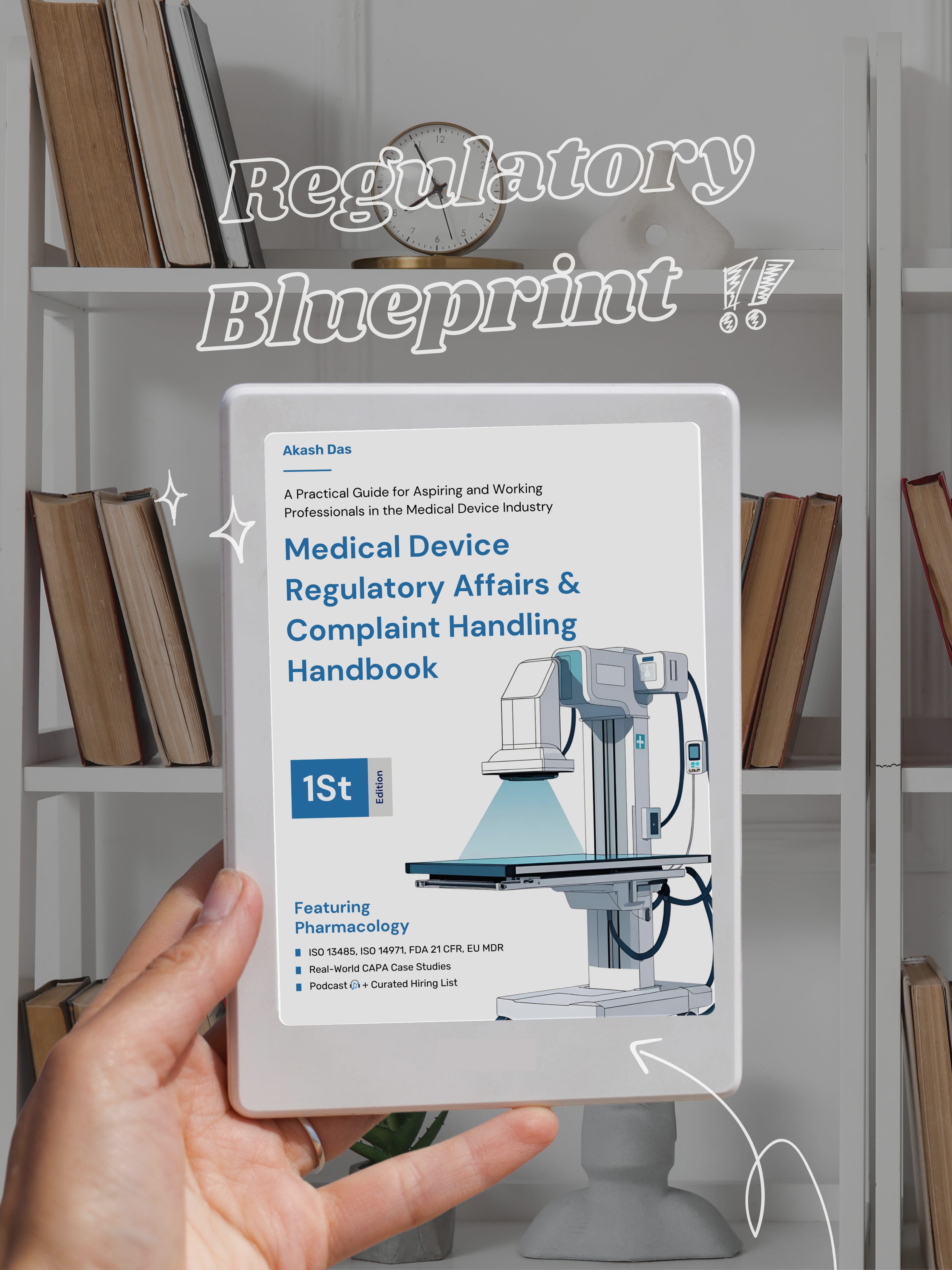
💬 DM me on WhatsApp to get your copy of the eBook.
Thanks for reading! Reply and tell me your worst audit finding story - let's learn from each other.
See you next Sunday ✨
– Akash Das
Let’s Connect on LinkedIn ☺️