Master ISO 14971 : 2019 | Practical Implementation & Integration | Your Complete 08-Week Implementation Guide Starts Here.
Medical Device Insights - Issue #28 March 15, 2026

Hi There, 👋
Welcome to the SERIES FINALE of our ISO 14971 Risk Management Mastery series! Over 8 weeks, we've covered every clause. Today, we bring it all together - your complete implementation roadmap and how to integrate risk management into your QMS seamlessly.
Why this series?
ISO 14971 is the global standard for Medical Device Risk Management Systems. It's the difference between safe devices and patient harm, between regulatory approval and warning letters.
📚 Series Complete: ISO 14971 Risk Management Mastery
Your 8-week journey - COMPLETE!
✅ Issue #21: Introduction - Why Risk Management is the Foundation
✅ Issue #22: Risk Management Planning (Clause 4)
✅ Issue #23: Risk Analysis (Clause 5)
✅ Issue #24: Risk Evaluation (Clause 6)
✅ Issue #25: Risk Control (Clause 7)
✅ Issue #26: Residual Risk & Risk/Benefit (Clauses 7-8)
✅ Issue #27: Production & Post-Production (Clause 9)
📍 Issue #28 (Today): Practical Implementation & Integration - FINALE!
📌 Congratulations - You Made It!
Over 8 weeks, you’ve learned:
Complete ISO 14971:2019 standard clause by clause
Risk management process from planning through post-production
Practical tools - FMEA, risk matrices, benefit-risk analysis
Integration with ISO 13485 and your QMS
Real-world examples from actual medical devices
You now have comprehensive knowledge of medical device risk management.
🎯 The Complete Risk Management Process
Visual overview:
┌─────────────────────────────────────────────────┐
│  CLAUSE 4: PLANNING                             │
│  - Define scope, roles, criteria                │
└────────────┬────────────────────────────────────┘
             ↓
┌─────────────────────────────────────────────────┐
│  CLAUSE 5: RISK ANALYSIS                        │
│  - Identify hazards & hazardous situations      │
│  - Estimate risks                               │
└────────────┬────────────────────────────────────┘
             ↓
┌─────────────────────────────────────────────────┐
│  CLAUSE 6: RISK EVALUATION                      │
│  - Compare to acceptability criteria            │
│  - Decide: Accept or reduce?                    │
└────────────┬────────────────────────────────────┘
             ↓
┌─────────────────────────────────────────────────┐
│  CLAUSE 7: RISK CONTROL                         │
│  - Implement controls (design/protective/info)  │
│  - Verify effectiveness                         │
│  - Evaluate residual risk                       │
└────────────┬────────────────────────────────────┘
             ↓
┌─────────────────────────────────────────────────┐
│  CLAUSE 8: OVERALL EVALUATION                   │
│  - Overall residual risk acceptable?            │
│  - Benefit-risk favorable?                      │
│  - Risk management report                       │
└────────────┬────────────────────────────────────┘
             ↓
         LAUNCH
             ↓
┌─────────────────────────────────────────────────┐
│  CLAUSE 9: POST-PRODUCTION                      │
│  - Collect information                          │
│  - Review for risk impact                       │
│  - Update risk management                       │
│  - Continuous improvement                       │
└────────────┬────────────────────────────────────┘
             ↓
      (Back to top - continuous cycle)
🗺️ Your Implementation Roadmap
Phase 1: Foundation
Objective: Establish risk management infrastructure.
Activities:
Document risk management procedure.
Create a risk management plan template.
Define severity and probability scales.
Create a risk matrix.
Establish acceptability criteria.
Define roles and responsibilities.
Identify risk management tools needed.
Train risk management team.
Deliverables:
Risk management procedure.
Risk management plan template.
Risk acceptability criteria document.
FMEA template.
Training records.
Owner: Quality/Regulatory Manager + Risk Management Lead
Phase 2: Pilot Project
Objective: Apply risk management to one device.
Activities:
Select pilot device (existing or in development).
Create a risk management plan for the pilot.
Conduct risk analysis (identify hazards, estimate risks).
Perform risk evaluation.
Identify and implement risk controls.
Verify control effectiveness.
Evaluate residual risks.
Complete benefit-risk analysis (if applicable).
Prepare risk management report.
Lessons learned session.
Deliverables:
Complete risk management file for pilot device.
Risk management report.
Lessons learned document.
Process improvements identified.
Owner: Cross-functional team led by Risk Management Lead.
Phase 3: Rollout
Objective: Apply to all devices
Activities:
Prioritize devices for risk management implementation.
Apply the process to each device/device family.
Incorporate lessons learned from the pilot.
Train additional personnel as needed.
Establish risk management file structure.
Link to design control processes.
Link to post-market surveillance.
Link to the CAPA system.
Deliverables:
Risk management files for all devices.
Integrated QMS procedures.
Training completion for all relevant personnel.
Owner: Risk Management Lead with functional support.
Phase 4: Post-Market Integration (Month 7 onwards)
Objective: Continuous risk management.
Activities:
Establish post-market information collection.
Define review frequency and triggers.
Integrate with complaint handling.
Integrate with adverse event reporting.
Integrate with CAPA.
Schedule periodic reviews.
Define the field action process.
Implement continuous improvement.
Deliverables:
Post-market surveillance plan.
Review schedule.
Integration with existing QMS processes.
Updated procedures.
Owner: Quality/Regulatory with cross-functional support
🎯 Integration with ISO 13485
Key integration points:
Clause 7.1 (Product Realization Planning):
ISO 13485 requires                ISO 14971 provides
"Document risk             →      "Complete risk
management process"               management framework"
Clause 7.3.3 (Design Inputs):
"Applicable outputs of risk management" → Risk analysis outputs become design inputsClause 7.3.4 (Design Outputs):
Design outputs must address risks → Risk controls implemented in designClause 7.3.6 & 7.3.7 (V&V):
Verification/Validation → Verify risk control effectivenessClause 8.2.1 (Feedback):
"Input to risk management" → Post-production information reviewClause 8.5.2 (CAPA):
Corrective actions → May trigger risk management update Practical integration:
1. Design History File contains Risk Management File.
Don’t create separate silos.
Risk analysis informs design inputs.
Risk controls are design outputs.
V&V verifies risk controls.
2. Post-market data flows to risk management.
Complaints reviewed for risk signals.
CAPA findings update the risk file.
Adverse events trigger risk reassessment.
3. Risk-based decision making throughout QMS
Supplier evaluation: Risk-based.
Process validation: Risk-based scope.
Change control: Risk-based evaluation.
CAPA prioritization: Risk-based.
🎯 Common Implementation Challenges
Challenge #1: “We don’t have time.”
Reality: You don’t have time NOT to do risk management.
Solution:
Start small (pilot project).
Build competency gradually.
Integrate into existing processes (don’t create parallel systems).
Use templates and tools to improve efficiency.
Challenge #2: “It’s too complicated.”
Reality: Risk management IS complex, but systematic.
Solution:
Break into steps (plan, analyze, evaluate, control, review).
Use structured tools (FMEA, checklists).
Train the team thoroughly.
Learn from examples (similar devices).
Challenge #3: “No one wants to do it.”
Reality: Risk management is seen as a regulatory burden.
Solution:
Show value (prevent field failures, avoid recalls).
Involve a cross-functional team (not just QA).
Celebrate successes (risks prevented).
Make it part of culture, not a compliance exercise.
Challenge #4: “We already have FMEA.”
Reality: FMEA is ONE TOOL, not complete risk management.
Solution:
Explain the ISO 14971 framework.
Show how FMEA fits within it.
Demonstrate gaps in the current approach.
Enhance existing FMEA with ISO 14971 requirements.
Challenge #5: “Post-market is QA’s job.”
Reality: Post-market risk review needs cross-functional input.
Solution:
Define roles clearly (QA collects, risk team reviews).
Establish a systematic review process.
Show impact on product improvement.
Track the value of post-market findings.
🎯 Building Risk Management Competency
Training needs:
Level 1: Awareness (All personnel)
What is risk management?
Why does it matter?
Your role in risk management
Level 2: Application (Design, QA, RA)
How to perform risk analysis
How to use FMEA
How to implement controls
How to verify effectiveness
Level 3: Leadership (Risk Management Lead, Management)
ISO 14971 standard deep dive
Risk acceptability criteria development
Benefit-risk analysis
Regulatory expectations
Audit readiness
Training methods:
Formal training (ISO 14971 courses)
Internal workshops
Hands-on practice (pilot project)
Mentoring
Case studies
Audit participation
🎯 Tools and Resources
Essential tools:
1. Risk management software (optional but helpful)
Dedicated risk management platforms
FMEA software
Document management systems
Complaint/CAPA systems with risk integration
2. Templates
Risk management plan
FMEA worksheet
Risk control verification template
Benefit-risk analysis framework
Risk management report outline
3. Reference materials
ISO 14971:2019 standard
ISO/TR 24971:2020 (guidance)
ISO 13485:2016
Applicable product standards
Regulatory guidance documents
4. Databases
FDA MAUDE
EU NANDO
Literature databases
Similar device information
🎯 Measuring Success
Key performance indicators (KPI) :
Process metrics:
% of devices with complete risk management files.
% of risk management plans following the template.
% of reviews completed on schedule.
Training completion rate.
Outcome metrics:
Risk-related field actions (should decrease over time).
Risk-related complaints (trend should improve).
Risk-related regulatory findings (should be minimal).
Time from risk identification to control implementation.
Quality metrics:
Audit findings on risk management (should decrease).
Risk file completeness (should be 100%).
Post-market review timeliness (should meet targets).
📊 What You’ve Accomplished
Knowledge gained:
✅ Complete ISO 14971:2019 standard
✅ Risk management planning and criteria setting
✅ Hazard identification and risk analysis
✅ Risk evaluation and ALARP principle
✅ Risk control hierarchy and implementation
✅ Benefit-risk analysis methodology
✅ Post-production surveillance and updates
✅ Integration with ISO 13485 and QMS
Skills developed:
✅ Risk management planning
✅ FMEA execution
✅ Risk acceptability decision-making
✅ Risk control selection and verification
✅ Benefit-risk assessment
✅ Post-market risk review
✅ Risk file management
✅ Audit readiness
🙏 Thank You for This Journey
You stuck with it. You completed the series. You’re ready.
👉 Master PMS Interview Topics
This question trips up candidates because it combines multiple expertise areas:
✅ FDA 21 CFR
✅ EU MDR
✅ ISO 13485
✅ ISO 14971
✅ CAPA & Complaint Handling
✅ Real Case Sudies + Dumy Audit Preperation + Free Podcase
Options:
🟦 eBook only – ₹199
🟥 Live Class + Free eBook – ₹149/hr
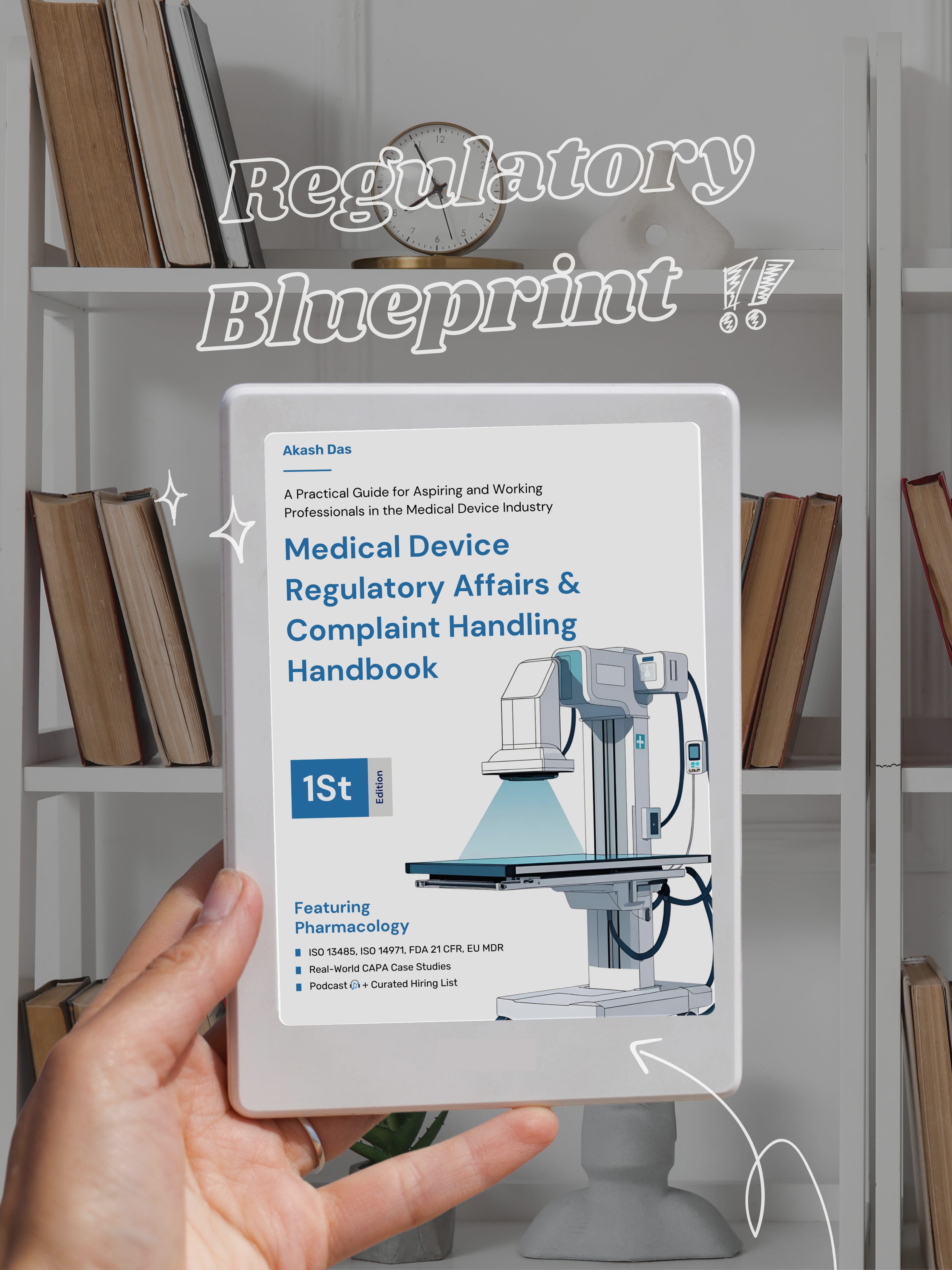
💬 DM me on WhatsApp to get your copy of the eBook.
Thanks for reading! Reply and tell me your worst audit finding story - let's learn from each other.
See you next Sunday ✨
– Akash Das
Let’s Connect on LinkedIn ☺️