What's Changing in Medical Device Regulations in 2026.
Medical Device Insights – Issue #20 January 18, 2026

Hi There, 👋
We just completed our 10-week ISO 13485 series, and now we’re back to weekly insights on what matters in medical device compliance. This week: what regulatory changes are coming in 2026 that you need to prepare for NOW.
📌 What's Changing in Medical Device Regulations in 2026
Why does this matter?
Regulatory requirements don’t stand still. What was compliant in 2025 might not be sufficient in 2026. Companies that anticipate changes stay ahead. Those who react late face:
Regulatory findings
Market access delays
Costly retrofits
Competitive disadvantage
Today’s focus: The major regulatory shifts happening in 2026 across key markets.
🇺🇸 FDA Updates for 2026
1. Cybersecurity Requirements (EFFECTIVE MARCH 2026)
What’s changing:
The FDA’s new cybersecurity guidance becomes enforceable for premarket submissions.
New requirements:
Secure by Design: Cybersecurity must be designed in, not added later.
Software Bill of Materials (SBOM): Must provide transparency of software components.
Vulnerability Management: Must have a plan for addressing vulnerabilities throughout the lifecycle.
Update/Patch Capability: Devices must be capable of security updates.
Who’s affected:
All devices with software.
Connected devices.
Devices with network capabilities.
Mobile medical apps.
Action needed:
Review the cybersecurity risk assessment.
Develop an SBOM for your devices.
Establish a vulnerability monitoring process.
Ensure an update/patch mechanism exists.
Update design controls to include cybersecurity.
Why it matters: Cybersecurity is now considered a safety issue, not just an IT issue. Non-compliance = no clearance.
2. UDI for Device Identifiers (ONGOING COMPLIANCE)
What’s changing:
Final compliance dates for UDI requirements continue rolling out.
2026 timeline:
Class I devices: Direct marking requirements
Convenience kits: UDI requirements
Software as Medical Device (SaMD): UDI in software display
Action needed:
Ensure UDI is assigned to all applicable devices.
Verify GUDID database entries are complete and accurate.
Implement direct marking (if required for your class).
Update labeling to include UDI.
Common gaps:
UDI is not on the lowest level of packaging.
GUDID data is incomplete or inaccurate.
Direct marking not implemented.
Software not displaying UDI.
3. QMSR (Quality Management System Regulation) Updates
What’s changing:
FDA continues harmonizing 21 CFR Part 820 with ISO 13485:2016.
Expected updates:
Risk-based approach emphasis.
Software validation requirements clarified.
Process validation expectations updated.
Post-market surveillance requirements strengthened.
Action needed:
Stay current with ISO 13485:2016 (provides foundation).
Monitor FDA announcements.
Prepare for potential Part 820 revision.
4. Pre-Cert Program Evolution
What’s changing:
Insights from the FDA’s Digital Health Pre-Certification pilot program are being applied to regulations.
Impact:
Organizational excellence considerations.
Real-world performance monitoring expectations.
Faster pathways for demonstrated quality organizations.
Action needed:
Build robust post-market surveillance.
Demonstrate organizational quality culture.
Invest in real-world data collection capabilities.
EU MDR Developments for 2026
1. MDR Full Application (ALL DEVICES)
What’s changing:
The transition period ended in May 2024, but compliance monitoring intensifies in 2026.
Focus areas for 2026:
Clinical evaluation: Deeper scrutiny of clinical data.
Post-market surveillance: Expects robust systems.
Person Responsible for Regulatory Compliance (PRRC): Role compliance verified.
Economic operators: Distributor/importer obligations enforced.
Action needed:
Ensure clinical evaluation meets MDR standards (not MDD).
Strengthen post-market clinical follow-up (PMCF).
Verify PRRC has proper qualifications and authority.
Review economic operator agreements.
2. EUDAMED Fully Operational
What’s changing:
European Database on Medical Devices (EUDAMED) is becoming mandatory for:
Device registration
UDI database
Actor registration
Clinical investigations
Vigilance reporting
Market surveillance
2026 requirements:
All devices must be registered in EUDAMED.
UDI data must be in the EU UDI database module.
Vigilance reports submitted through EUDAMED.
Action needed:
Register as an economic operator in EUDAMED.
Submit device registrations.
Enter UDI data into EU database.
Transition vigilance reporting to EUDAMED.
Train staff on EUDAMED use.
3. Notified Body Capacity Issues
What’s reality:
Limited Notified Body capacity continues affecting timelines.
2026 challenges:
Longer wait times for initial assessments.
Increased scrutiny in audits.
Higher costs for NB services.
Capacity prioritization (higher risk devices first).
Action needed:
Start NB engagement early (12-18 months before needed).
Maintain a strong relationship with the current NB.
Ensure technical documentation is complete upfront.
Build in longer timelines for regulatory submissions.
4. Sustainability Requirements (Emerging)
What’s changing:
EU pushing sustainability in medical devices.
Expected requirements:
Environmental impact assessments
Recyclability considerations
Single-use plastic reduction
Carbon footprint reporting
Action needed:
Monitor EU Green Deal developments.
Consider sustainability in design.
Evaluate packaging materials.
Prepare for environmental reporting.
🌏 Other Key Markets
India - Medical Device Rules
What’s changing:
India’s Medical Device Rules (2017) enforcement is intensifying.
2026 focus:
Licensing requirements are strictly enforced.
Quality management system inspections are increasing.
Import regulations are tightening.
Local clinical data expectations.
Action needed:
Ensure proper licensing for the device class.
Maintain ISO 13485 certification.
Prepare for CDSCO inspections.
Consider India-specific clinical data needs.
Japan - PMDA Requirements
What’s changing:
PMDA is increasing international harmonization but maintaining unique requirements.
2026 developments:
MDSAP recognition is expanding.
Post-market safety reporting expectations are increasing.
Clinical data requirements for certain devices.
Action needed:
Consider MDSAP certification (covers Japan + 4 other countries).
Strengthen post-market surveillance.
Engage with PMDA early in development.
China - NMPA Reforms
What’s changing:
NMPA continues regulatory reforms.
2026 trends:
Innovation pathways are expanding (for truly novel devices).
Post-market surveillance expectations are increasing.
Registration timelines are improving (for well-prepared submissions).
Local clinical data are often required.
Action needed:
Engage NMPA early (pre-submission meetings).
Plan for China-specific clinical studies.
Ensure local representation (agent/entity).
Maintain strong post-market surveillance.
🔮 Cross-Market Trends to Watch
Trend 1: AI/ML Devices - Regulatory Clarity Emerging
What’s happening:
Regulators worldwide are developing frameworks for AI/ML medical devices.
Key developments:
FDA: AI/ML action plan implementation.
EU: AI Act + MDR intersection.
Canada: AI guidance documents.
What this means:
Pre-determined change control plans (PCCP) are becoming standard.
Algorithm transparency requirements.
Real-world performance monitoring is mandatory.
Training data diversity expectations.
Action for AI/ML developers:
Document algorithm development rigorously.
Plan for continuous learning/updates.
Establish real-world performance monitoring.
Prepare for transparency requirements.
Trend 2: Digital Health - Regulations Catching Up
What’s happening:
Software as Medical Device (SaMD) regulations are maturing.
Expectations:
Cybersecurity baseline requirements (all markets).
Interoperability standards.
Data privacy/GDPR compliance.
Cloud infrastructure validation.
Action for digital health:
Treat cybersecurity as a safety issue.
Implement privacy by design.
Validate cloud services.
Plan for continuous updates.
Trend 3: Post-Market Surveillance - From Reactive to Proactive
What’s happening:
All major regulators expect robust, proactive post-market systems.
Requirements strengthening:
Real-world data collection.
Proactive trend analysis.
Faster response to signals.
Transparency in reporting.
Action needed:
Upgrade complaint handling systems.
Implement real-time data analytics.
Develop proactive monitoring plans.
Strengthen vigilance capabilities.
Trend 4: Sustainability - No Longer Optional
What’s happening:
Environmental considerations entering medical device regulations.
Where it’s going:
EU leading with environmental requirements.
Other markets are following.
Lifecycle environmental impact assessments.
Circular economy principles.
Action needed:
Design for sustainability.
Evaluate packaging materials.
Consider product end-of-life.
Prepare for environmental reporting.
Trend 5: Supply Chain Transparency
What’s happening:
Regulators want visibility into the entire supply chain.
Emerging requirements:
Component/material traceability.
Supplier qualification documentation.
Change notification requirements.
Supply chain risk management.
Action needed:
Map your supply chain (including sub-tier).
Strengthen supplier qualification.
Implement change notification agreements.
Assess supply chain risks.
👉 Master PMS Interview Topics
This question trips up candidates because it combines multiple expertise areas:
✅ FDA 21 CFR
✅ EU MDR
✅ ISO 13485
✅ ISO 14971
✅ CAPA & Complaint Handling
✅ Real Case Sudies + Dumy Audit Preperation + Free Podcase
Options:
🟦 eBook only – ₹299
🟥 Live Class + Free eBook – ₹199/hr
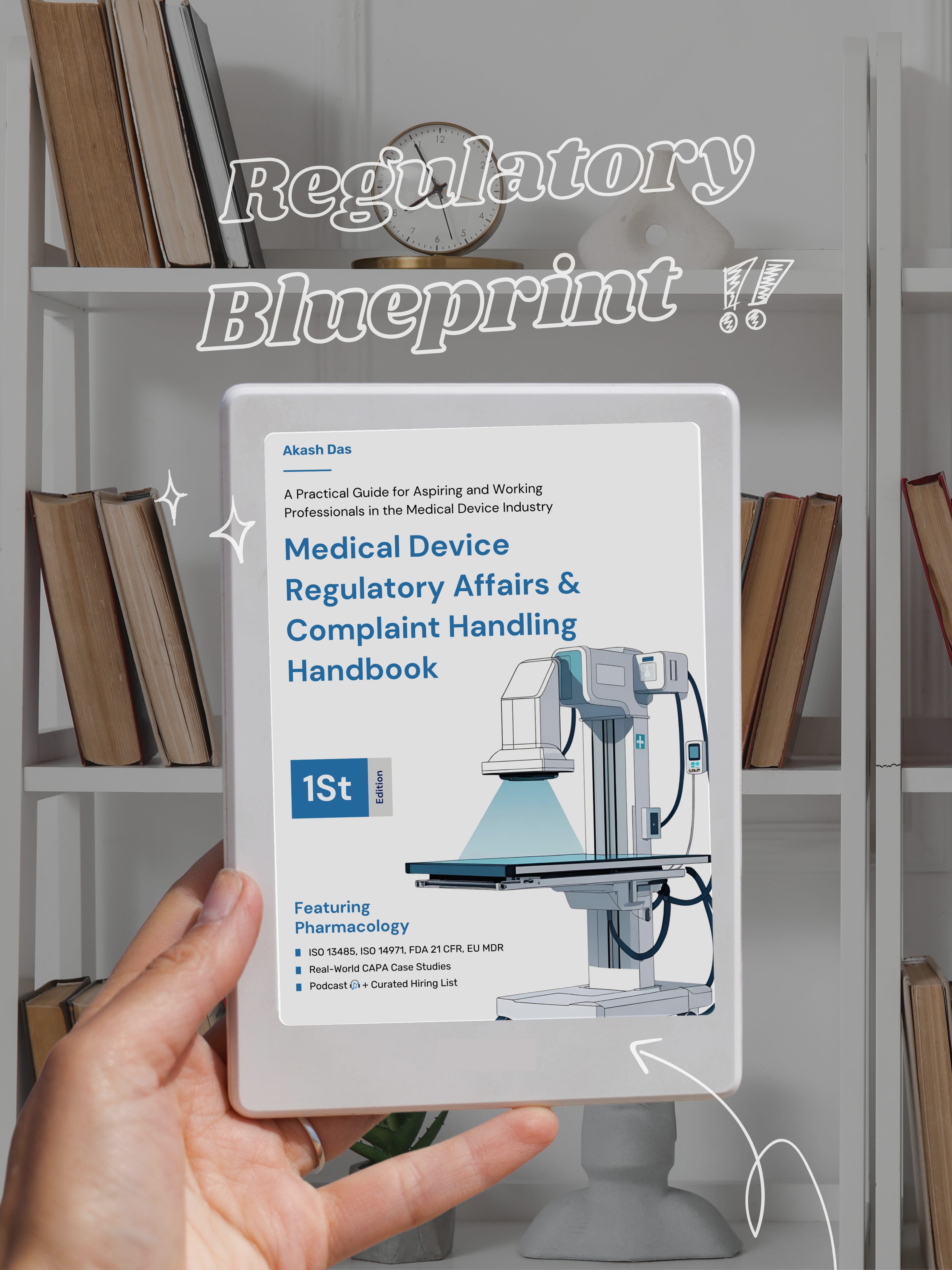
💬 DM me on WhatsApp to get your copy of the eBook.
Thanks for reading! Reply and tell me your worst audit finding story - let's learn from each other.
See you next Sunday ✨
– Akash Das
Let’s Connect on LinkedIn ☺️